How to Reduce Radon in a Basement: The Options Compared
Last updated: By RadonIndex Research Team
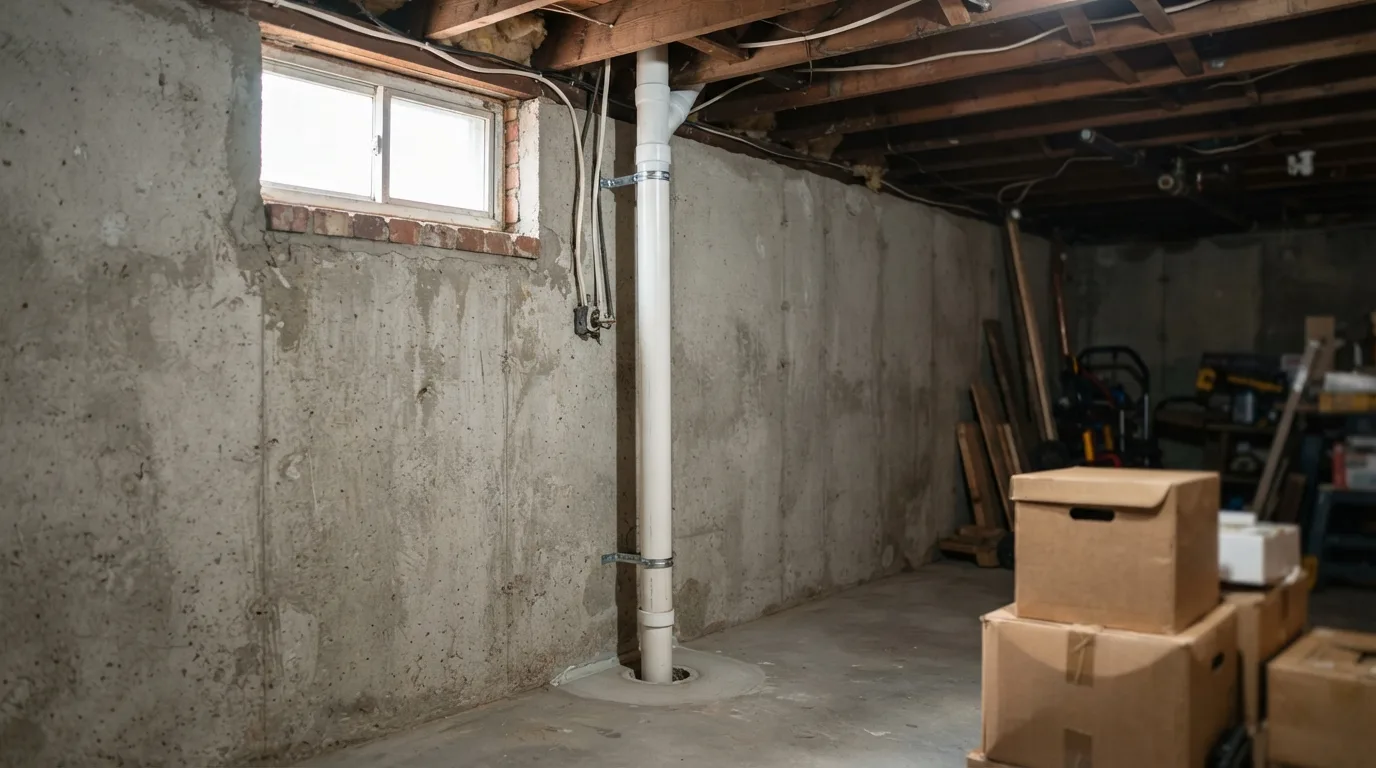
Which options does Health Canada list for reducing radon in a basement?
Health Canada lists three ways to lower radon in an existing home: active soil depressurization, balanced ventilation and sealing where soil gas gets in. Active soil depressurization, shortened to ASD, is a sealed pipe through the basement floor with a fan that runs all the time and pulls soil gas from under the slab to the outdoors. Balanced ventilation means a heat recovery ventilator (HRV) or energy recovery ventilator (ERV), a unit that brings in outdoor air and exhausts stale indoor air. Sealing closes openings such as the sump, floor drains and the joint where the floor meets the wall.
Health Canada's Reduce radon in your home factsheet, published in September 2026, describes the first two and says entry points should be sealed to help a ventilation system work. Health Canada's 2014 Radon Reduction Guide adds that "A single method may do the job, but sometimes a combination of several methods must be used". How the pipe and fan work is explained in how a radon mitigation system works, and the openings radon uses are mapped in where radon gets into a Toronto home.
How much does each option lower radon, by Health Canada's figures?
ASD lowers radon far more than anything else, and ventilation and sealing each help much less. Health Canada's September 2026 factsheet says ASD "can reduce radon levels by 90% or more" and that ventilation systems "generally reduce radon levels by only 20% to 50%". Health Canada's Reducing radon levels page gives a lower figure for a mitigation system, which "in most homes will reduce the radon level by more than 80%".
Health Canada has also measured what happened in real homes. Its mitigation follow-up study, posted in 2018, contacted people in 2015 whose homes had tested near or above the guideline in its national surveys, and offered those who had acted a free long-term test afterwards. Where people used only one method, the study reports average drops of about 13% for sealing entry routes, 21% for more ventilation, 23% for sealing or covering the sump and 65% for ASD. The study also breaks down ASD results by who installed the system: 19% on average where homeowners fitted it themselves, against 81% for contractors and 88% for certified radon mitigators.
These are averages, so they show which option to start with, not what one basement will reach.
Which option fits your test result?
The size of the drop you need helps decide the method, so a long-term test result comes first. Health Canada's 2014 Reduction Guide says "When large radon reductions (50 per cent or more) are desired, active soil depressurization is almost always the recommended approach". A result more than double the guideline needs a cut of more than 50 percent just to reach it.
Health Canada's radon guideline sets that line at 200 becquerels per cubic metre (Bq/m3), the unit radon is measured in. Above it, "Health Canada recommends that you take corrective action to lower the level within 1 year". For a result only a little above 200, the Reduction Guide says "If smaller reductions are sufficient, the other radon reduction methods described below may be reasonable alternatives".
Health Canada's measurement guide says 200 "is not a recommended stopping point for mitigation if it is reasonable to go lower", so a fix that only just gets under the line is a weak target. And Health Canada's Reducing radon levels page says the effectiveness of ventilation and sealing "will be limited depending on how high the radon level is and the unique characteristics of each home".
The measurement guide also says short-term measurements "are not appropriate for informing mitigation decisions"; setting up a long-term test is covered in how to test a GTHA home for radon.
Which kind of depressurization fits your basement?
It depends on what is under and around the floor. Health Canada's 2014 Reduction Guide describes suction through the slab and three variations. Where a basement has a sump pit, the sump "can be capped and sealed so that it can continue to drain water and also serve as the location for a radon suction pipe". Suction on the drain tile around the footing is "worth considering if it is certain the tile forms a complete loop around the foundation". A crawl space with a soil floor gets a thick plastic sheet sealed to the walls, with suction beneath it. A house with a basement under one part and a crawl space or slab under another part may need "a combination of radon-reduction techniques".
To choose, the guide says a certified professional "will likely perform one or more diagnostic tests". A smoke test shows where air moves in. A pressure field extension test uses a shop vacuum to see how easily air moves under the slab and to "estimate the number of suction points and fan size needed".
On a Toronto semi or row house, ask where the exhaust will come out and how close it sits to the house next door. The guide says a fan in a cold attic or garage can suffer condensation and possibly ice, and that an indoor fan with a short exhaust near ground level "is an effective technique" in field studies. It does not settle the best exhaust spot for houses built close together, so ask the installer to show on the quote where the fan and the exhaust will go, and why that spot suits a house this close to its neighbour.
For new houses, Health Canada's 2026 factsheet recommends that "all new homes include a passive soil depressurization (PSD) system", a pipe from under the slab to the roof with no fan, and says "PSD can reduce radon levels by 40-90% and can easily be upgraded to an ASD system by adding a fan". The radon rough-in that the 2024 Ontario Building Code asks for in a new low-rise house is a capped pipe, not a working passive stack, as the radon rough-in in a new Ontario home explains.
When are ventilation and sealing worth doing?
They are worth doing alongside a system, or on their own where only a modest drop is needed. Health Canada's 2014 Reduction Guide says the effect of ventilation "is limited and only appropriate for situations where only modest reductions are needed", and that it works best in airtight houses rather than drafty ones. An HRV needs balanced intake and exhaust "so that the house is not depressurized, which can draw in more radon". Health Canada's 2026 factsheet adds that ventilation systems "need to be operated continuously, be well maintained", and that entry points should be sealed "to maximize the efficacy of a ventilation system".
Sealing is part of almost every job but not a fix by itself. The guide says "because it is difficult to identify, access and permanently seal all openings it is not a standalone technique for reducing radon levels", while calling it "a basic part of most approaches to radon reduction". The openings it names first are an open sump, which can take an airtight cover, floor drains, which can take special traps, and the joint between the foundation wall and the floor, which "can be a major contributor to the radon levels in a home". Seals also age: "As the house ages and settles, the seals can deteriorate".
Does it matter who installs the system?
Yes, by a wide margin in Health Canada's own data. In its mitigation follow-up study, ASD systems that homeowners installed themselves cut radon by 19% on average, against 81% for contractors and 88% for certified radon mitigators. Health Canada's Reducing radon levels page recommends a contractor "certified as a radon mitigation professional from the Canadian National Radon Proficiency Program (C-NRPP)", the national program that certifies radon workers. Certification belongs to a person, so ask the installer for their certification number and enter it on the C-NRPP certification check. What a written quote should include is in how to read a radon mitigation quote, and published price ranges for each system type are on the radon mitigation cost guide.
Of the 35 companies RadonIndex lists in the Greater Toronto and Hamilton Area, 12 name radon mitigation on their own website, and 4 of those 12 say on their own website that they are C-NRPP certified. RadonIndex checks none of these claims, as its methodology page explains. The index does not record which methods a company installs or whether it runs diagnostic tests, so ask both. The companies are listed on the radon mitigation page.
How do you know the fix worked?
A test after the work is the only proof. Health Canada's measurement guide says "The only way to determine the efficacy of a mitigation system is by testing". Health Canada's 2026 factsheet asks for a short test by a certified professional once the system is on, then "a long-term radon test in the same location as your original test" during the first heating season, and a retest every five years. Health Canada's 2014 Reduction Guide adds: "To avoid conflict of interest, the test should not be performed by the company that installed the radon mitigation system". What each test is for, and what to do with a high result, is in retesting after radon mitigation.
Frequently asked questions
Can you get rid of radon in a basement completely?
- No. Every method lowers radon rather than removing it, and Health Canada's radon guideline says "there is no level that is considered risk free". It adds: "The higher the radon concentrations, the sooner action should be taken to reduce levels to as low as practically possible." So ask an installer what level the design aims for, not only whether it will get under the guideline of 200 becquerels per cubic metre (Bq/m3).
Does sealing the sump pit lower radon?
- Somewhat. In Health Canada's follow-up study, sealing or covering the sump as the only method lowered radon by about 23% on average, against 65% for ASD. Its 2014 Reduction Guide says a sump "can be capped and sealed so that it can continue to drain water and also serve as the location for a radon suction pipe", so a sealed lid can become part of a full system.
Can I install a radon mitigation system myself?
- You can, but Health Canada's own data argues against it. In its follow-up study, ASD systems that homeowners installed cut radon by 19% on average, against 81% for contractors and 88% for certified radon mitigators. Its 2014 Reduction Guide says the work "requires specific technical knowledge and skills to ensure the job is done properly".
How long does a radon mitigation system take to install?
- Health Canada's 2026 factsheet says a system "can usually be installed in less than a day". Knowing whether it worked takes longer: the same factsheet asks for a long-term test during the first heating season after installation.