How to Prove a Radon System Actually Worked
Last updated: By RadonIndex Research Team
The install is not the result
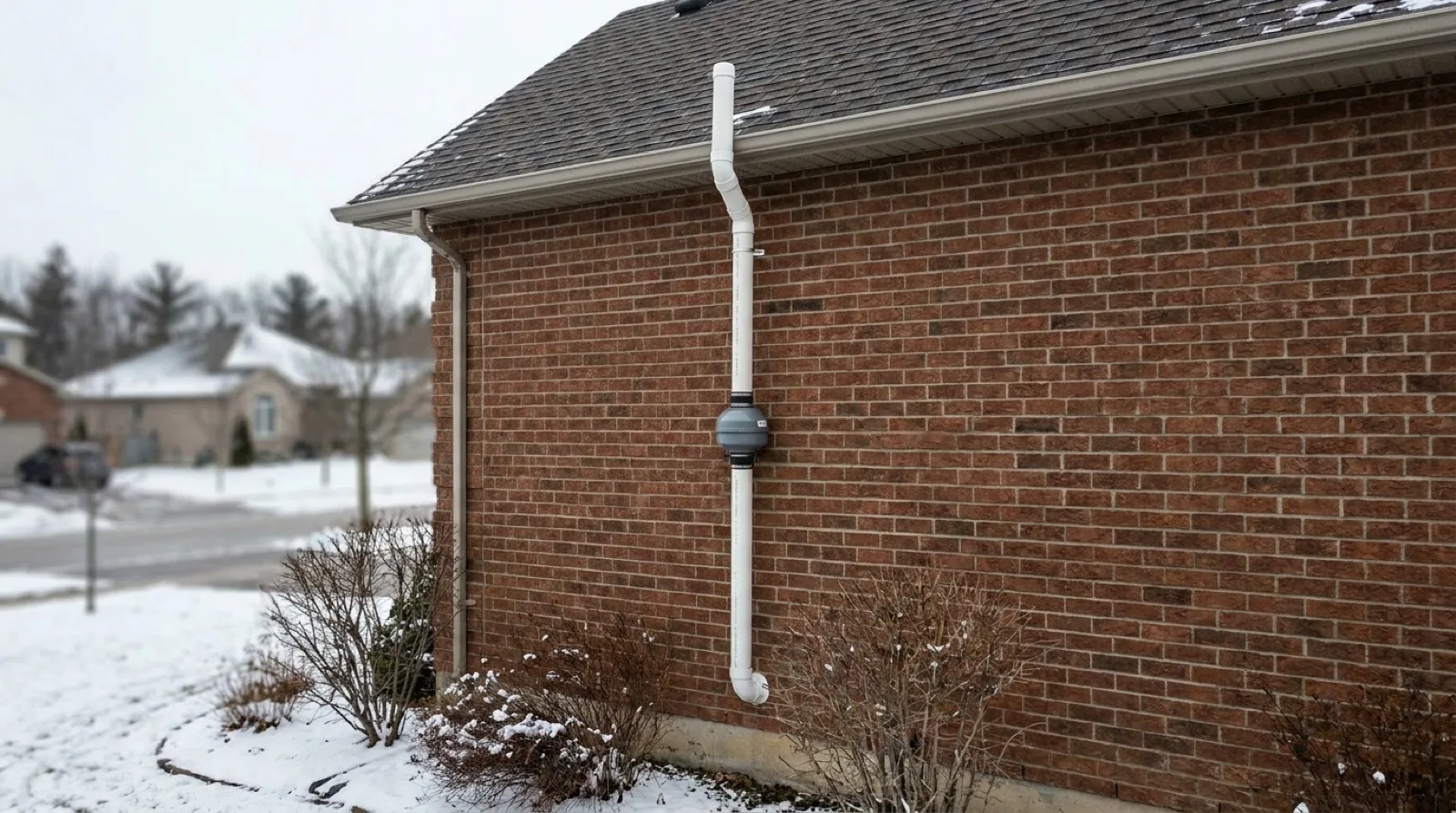
A radon mitigation system that has never been measured is an assumption with a fan attached. The pipe looks right, the fan hums, the invoice is paid, and nobody in the house knows whether the number came down.
This is not a hypothetical worry. The entire point of the work is a lower annual average, and the only thing that can report an annual average is a detector left in place for months. Health Canada's measurement guide lists testing "after any radon mitigation system is installed, to ensure performance of the system" as one of the occasions a home should be tested at all.
So the finished job has a document at the end of it, and the document is a test result. If your installer did not leave you one, the job is not finished, and our guide on reading a radon mitigation quote covers getting that written into the agreement before the crew arrives rather than after.
The two tests Health Canada asks for
There are two, and they answer different questions.
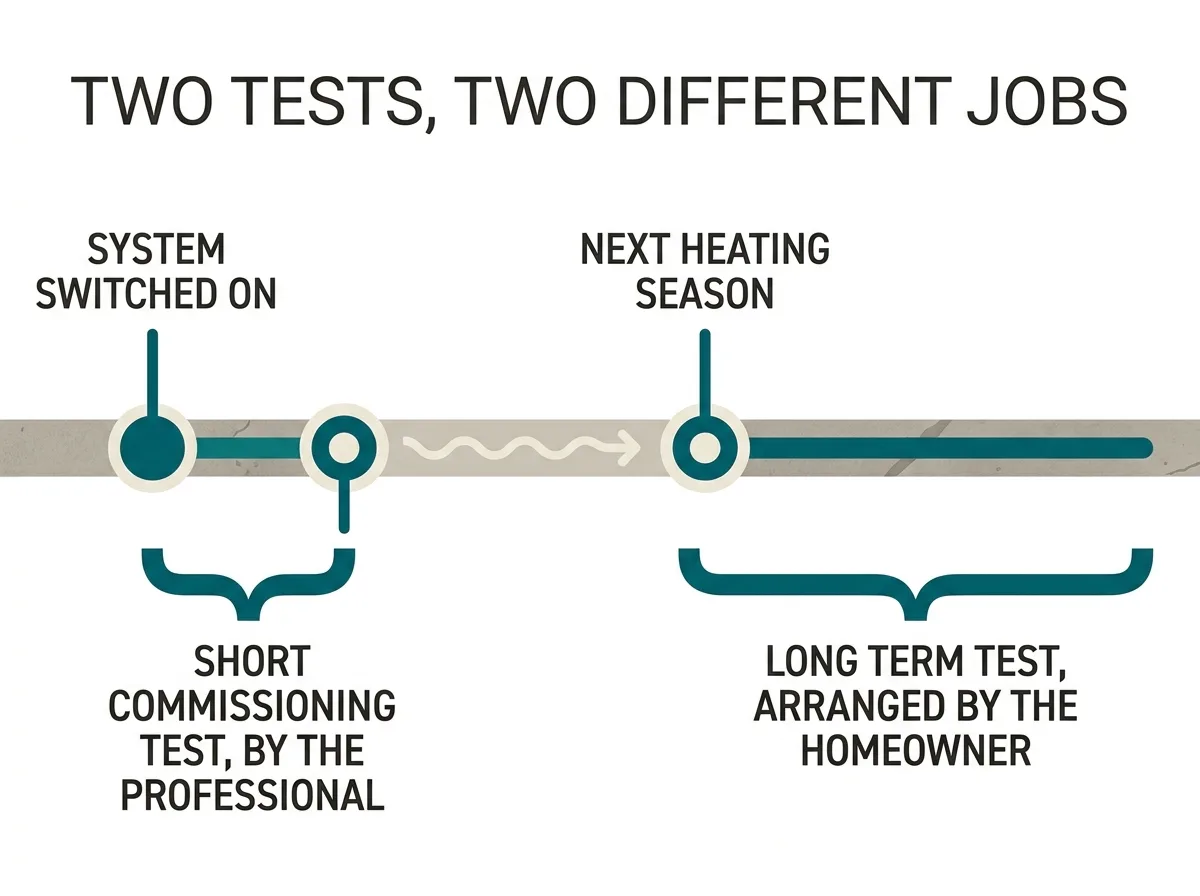
The first is immediate. Health Canada's reduction guide says "it is recommended that a certified C-NRPP professional carry out a short-term test after a system is activated to demonstrate that it is working effectively". C-NRPP is the Canadian National Radon Proficiency Program, the national scheme that certifies radon workers. This is the one case where a short test is the right tool: you are not estimating an annual average, you are checking that switching the fan on changed something. It is a commissioning check, like balancing a furnace.
The second is the real answer. The same guide continues that "the homeowner should also ensure that a long-term three-month test is performed the following fall /winter season to confirm that the annual average radon level has been reduced to below the Canadian guideline". Three months, in the heating season, in a room people actually use.
Notice who each one belongs to. The short test is the professional's, and it is reasonable to expect it as part of the work. The long term test is described as the homeowner's to arrange, in the following heating season, which is often well after the installer has gone. That gap is where it gets forgotten.
Then every few years, not never
A mitigation system is mechanical, and the part that does the work spins. Health Canada's reduction guide is explicit that this needs a schedule: "to verify continued performance of any radon-reduction system, an initial long-term measurement should be made within two years of the system activation and at five-year intervals afterwards".
Health Canada's measurement guide says the same thing in one line: "homes with active mitigation systems should be retested every 5 years to ensure the system is functioning as intended".
This matters more than it sounds, because a radon fan gives you nothing when it fails. There is no alarm, no smell, no change in the house. The level drifts back up over weeks and the family living there has no way to notice. Compare that with a furnace, which announces a failure the same evening.
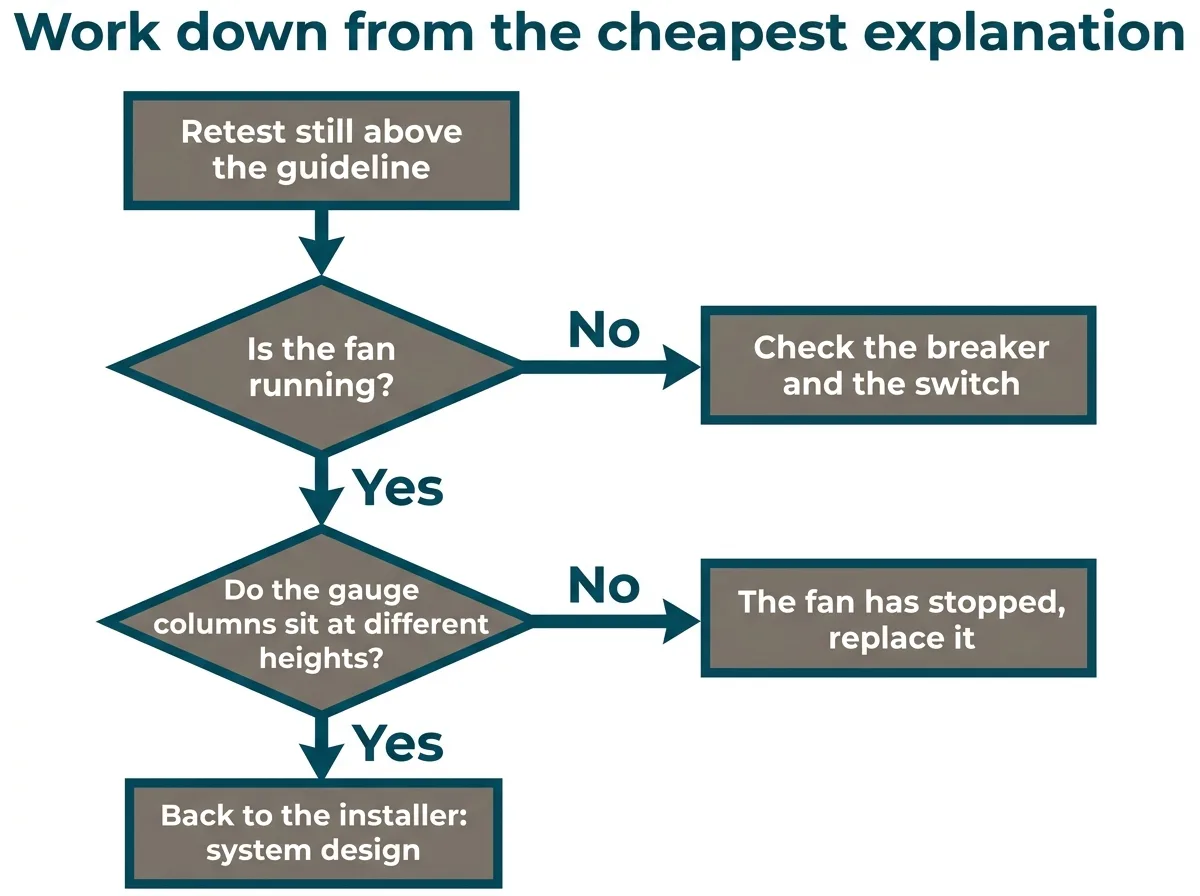
The cheap habit that closes the gap is a calendar entry, plus a glance at the manometer whenever you are down there. A manometer is the small pressure gauge fitted to the vent pipe, and it shows suction in the system. Two columns of liquid sitting at the same height means there is no pressure difference, which usually means the fan has stopped. How the whole assembly works is set out in how a radon mitigation system works.
What to do when the level is still high
Sometimes the retest comes back above the guideline anyway. Health Canada's radon guideline asks for corrective action where "the average annual radon level exceeds 200 Bq/m3 in the normal occupancy area of a building", and a system that has not achieved that has not finished its job. A becquerel per cubic metre, written Bq/m3, is the unit radon in air is measured in, and the normal occupancy area is the part of the home people actually live in.
This is a conversation with the installer, and it is a system design question rather than a homeowner maintenance question. Health Canada's reduction guide calls sub-slab depressurization "the most effective and reliable radon reduction technique" and says that "when large radon reductions (50 per cent or more) are desired, active soil depressurization is almost always the recommended approach". So the ceiling on what is achievable here is high, and a stubborn result usually points at how this particular system was built rather than at the method.
Four questions are worth asking, in roughly the order they tend to matter. Does the suction point reach the material under the whole slab, or only part of it? Does a mixed or split foundation need a second suction point? Is the fan sized for the resistance it is actually pulling against? And was the crawl space or cold cellar included at all?
What not to do is start caulking. Health Canada is direct about this: sealing openings "may help to lower radon levels in your home. However, because it is difficult to identify, access and permanently seal all openings it is not a standalone technique for reducing radon levels". Sealing supports a system. It does not substitute for one, and it is not the answer to a system that underperformed.
Before any of that, check the boring explanations first. Is the fan running. Has the breaker tripped. Was the system switched off during a renovation and never switched back on. Health Canada's guidance assumes a system operating normally, and a surprising share of disappointing retests are a machine that is simply off.
What re-checking costs
Very little, compared with what it is checking.
For the long term confirmation, a mail in kit is the right tool. Homeowner.ca puts a long term alpha track kit at $30 to $60 including the lab analysis, and the Evict Radon National Study sells an at cost kit at $53.99. An alpha track kit is a small plastic detector that records the marks radon leaves on a film inside it, and a laboratory reads the film after you post it back. Both figures, with the sentence each was taken from, are on our radon testing cost guide.
If you want to watch a system rather than certify it, Homeowner.ca prices a consumer continuous monitor at $200 to $350. A monitor is genuinely useful here in a way it is not for a first decision. You can park it near the system, see the level move when the fan is cycled, and catch a failure in days instead of years. The decision about whether the house is below the guideline still rests on the long term test.
And if the answer turns out to be a dead fan, Homeowner.ca puts replacement at $200 to $300 for the fan itself, plus labour. Set that against the $2,000 to $4,000 that the same source gives for a mitigation system in a typical Canadian home and the arithmetic is not close. The full table, every row traced to its source, is on the radon mitigation cost guide.
Who does this work in the GTHA
Recounted from our own data today, RadonIndex holds 35 company records for the Greater Toronto and Hamilton Area. 31 name radon testing on their own website and 12 name mitigation, and the overlap is the useful part: a company that does both can run the commissioning test and the fix.
Five of the 35 state a C-NRPP style certification claim in their own site text. That matters here more than almost anywhere else on this site, because Health Canada names a "certified C-NRPP professional" for the post-activation test specifically. We record the claim and the wording it appeared in. We verify nothing, we certify nobody, and no company can buy a position. Check the certification at its own source before you rely on it.
The lists are radon testing companies and radon mitigation contractors. Our methodology sets out how a company gets into either one.
Frequently asked questions
What should radon levels be after mitigation?
- Below the Canadian guideline, measured as an annual average. Health Canada asks for corrective action where the average annual level exceeds 200 Bq/m3 in the normal occupancy area, and says that in most situations a final level under 200 Bq/m3 can readily be achieved. A single short reading taken the day the fan went on does not establish that, which is why the guidance asks for a three month test the following heating season as well.
Why is my radon still high after mitigation?
- Check the cheap explanations first: the fan may not be running, the breaker may have tripped, or the system may have been switched off during work on the house. If it is running, this is a system design question for the installer. Common causes are a suction point that does not reach under the whole slab, a mixed foundation needing more than one, a fan undersized for the resistance, or a crawl space left out. Sealing cracks is not the fix. Health Canada says sealing is not a standalone technique for reducing radon levels.
Can radon come back after mitigation?
- Yes, and the usual reason is that the system stopped working rather than the ground changing. A radon fan fails silently, with nothing in the house to signal it. That is why Health Canada's reduction guide asks for a long term measurement within two years of activation, and at five year intervals after that. Its measurement guide says the same thing a different way, putting homes with active systems on a five year retest cycle.
How often should a radon mitigation system be retested?
- Health Canada's reduction guide asks for an initial long term measurement within two years of the system being activated, then at five year intervals afterwards. Its measurement guide states the ongoing cycle as every five years for homes with active mitigation systems. Retest sooner than that if you have changed the foundation, finished a basement, replaced the fan, or had the system switched off for any length of time.
How do I know the radon fan is still working?
- Look at the manometer, the small gauge fitted to the vent pipe. It holds a liquid in a U shaped tube, and the two columns sit at different heights while the system is pulling suction. Level columns mean no pressure difference, which usually means the fan has stopped. The gauge tells you the fan is running. It does not tell you the radon level, which is what the retest is for.