How to Read a Radon Mitigation Quote
Last updated: By RadonIndex Research Team
Why two quotes for the same house differ by thousands
The spread on radon mitigation is not mostly a spread in margin. It is a spread in what is being built.
A single suction point in an accessible basement, with clean gravel under the slab and a short exterior pipe run, sits at the bottom of every published range. Add a second foundation, a crawl space, a finished ceiling the pipe has to cross, or a reading high enough to need more than one suction point, and the same address becomes a different job.
RenoQuotes publishes the bands that come out of this: $2,000 to $4,500 where a sump or drain tile can be safely sealed and used as part of the system, $3,000 to $6,000 and up for crawl space sub membrane work, and $4,000 to $10,000 and up for complex or multi system installations. Homeowner.ca puts the Health Canada Reduction Guide range for a standard sub slab or sub membrane system at $2,000 to $3,000 for material and labour, and a typical Canadian install at $2,000 to $4,000 with a national average near $2,900.
So the first job when two numbers land in your inbox is not to pick the lower one. It is to work out whether they describe the same system. Every row above, with its source and its caveats, is on our radon mitigation cost guide.
The five things a quote has to name
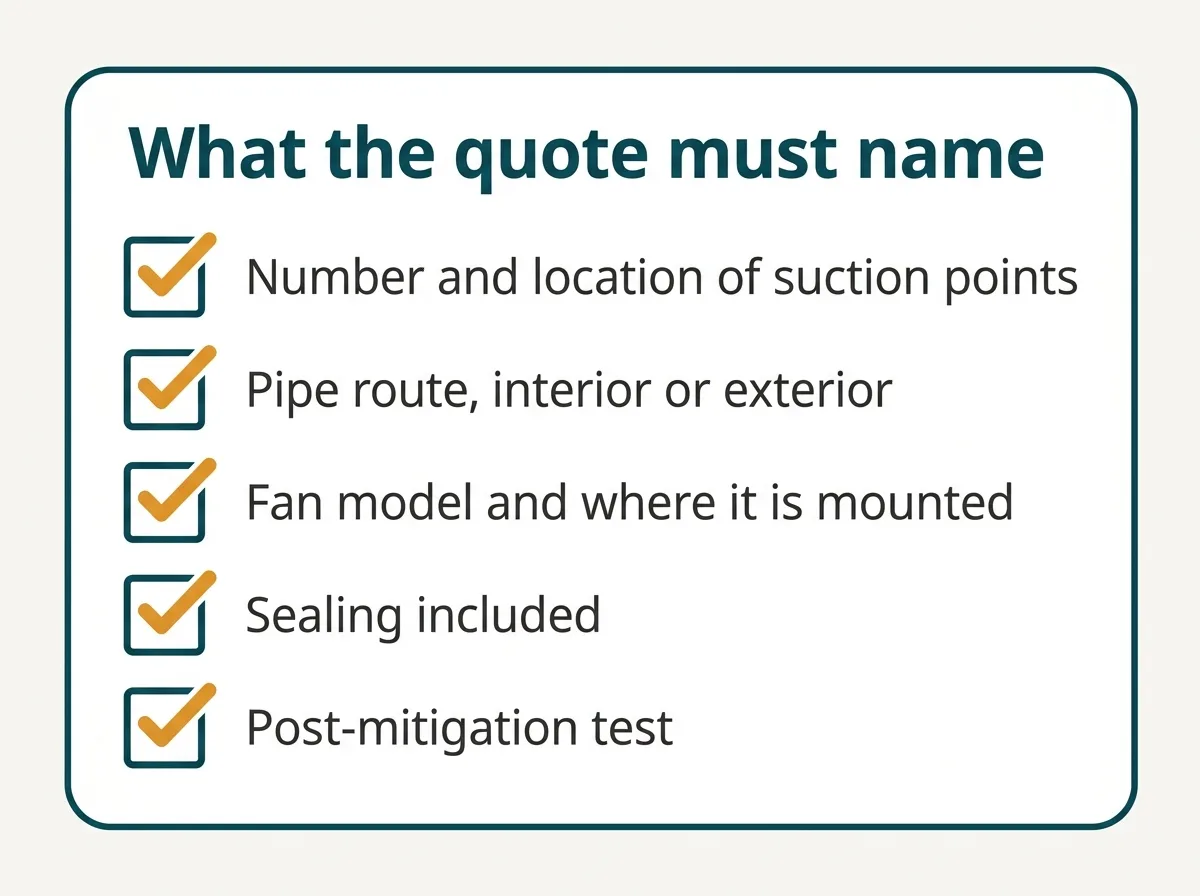
A quote you can actually compare says all five of these in writing.
How many suction points, and where. This is the single biggest driver of both price and performance. One point that cannot reach the far side of the slab leaves half the house unprotected.
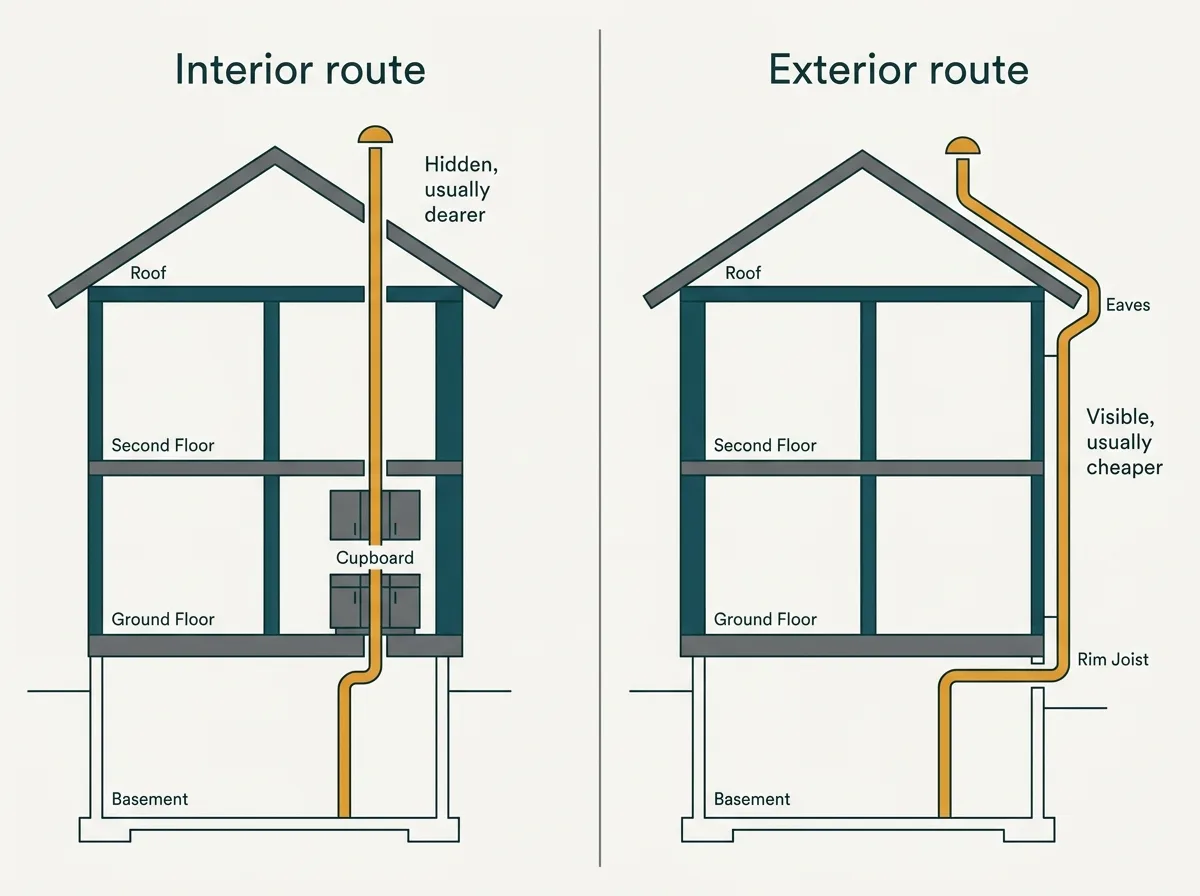
The pipe route. Interior routing, up through the house to the roof, is tidier and usually dearer. Exterior routing down a side wall is cheaper and more visible from the street. Both are legitimate; you want to know which one you are buying before the crew arrives.
The fan, by model, and where it will be mounted. The fan belongs outside the lived in space so that a leak on its pressurised side goes outdoors rather than into a bedroom.
The sealing included. The sump lid, the floor drain, the slab perimeter joint and large cracks are part of the work. If sealing is excluded, that is a real cost sitting outside the number you were given.
The post mitigation test. RenoQuotes notes that not every quote includes it. Ask directly, and if it is excluded, price it separately before you compare bids, because a system nobody measured is not a finished job.
What to ask about certification
In Canada, the certification that gets named is C-NRPP, the Canadian National Radon Proficiency Program, which certifies measurement and mitigation professionals. Certification is not a guarantee of a good install, but it is a floor, and it is the thing to ask about before the rest of the conversation.
RadonIndex has to be careful here, so we will be blunt about our own limits. Four of the 35 company records in this index carry a C-NRPP style claim in the text of the company's own website. We record the claim, we store the sentence it appeared in, and we verify nothing. We do not certify, accredit, endorse or vouch for any business listed, and no company can pay for a better position on this site. How records are gathered and what each field means is on our methodology page.
That means the check is yours to make. Ask for the certification number, ask whose name it is under, and confirm it against the C-NRPP's own public directory rather than against a logo on a website. A claim on a marketing page is a claim on a marketing page, which is exactly how this site treats it.
The costs that arrive after the invoice
A mitigation quote covers the install. Three costs live outside it.
Electricity and heat. The fan runs continuously, and a system that moves air out of the house pulls conditioned air with it. No source we could verify publishes a Canadian annual running cost for a radon fan, so we do not print one. Ask the installer for the fan's wattage and work it out against your own rate.
The fan itself, eventually. It is the only moving part in the system. Homeowner.ca puts a replacement at $200 to $300 for the fan, plus installation labour if you are not fitting it. Ask what the warranty covers and how long it runs, since that is the component the warranty question is really about.
Re testing. A system's output drifts as a house changes, and fans fail. Budget for a long term test every few years and after any renovation that changes how air moves through the building. A long term alpha track kit is $30 to $60 per Homeowner.ca, which makes it a small line beside the rest of the work.
If the home is newly built, there is one more question worth asking before you pay for anything. Ontario new homes carry radon coverage under the Tarion warranty, which can make mitigation the builder's responsibility where a certified test reads at or above the guideline. Confirm the current terms with Tarion directly.
What install day actually looks like
Knowing the shape of the work makes a quote easier to read, because you can see which line items are missing.
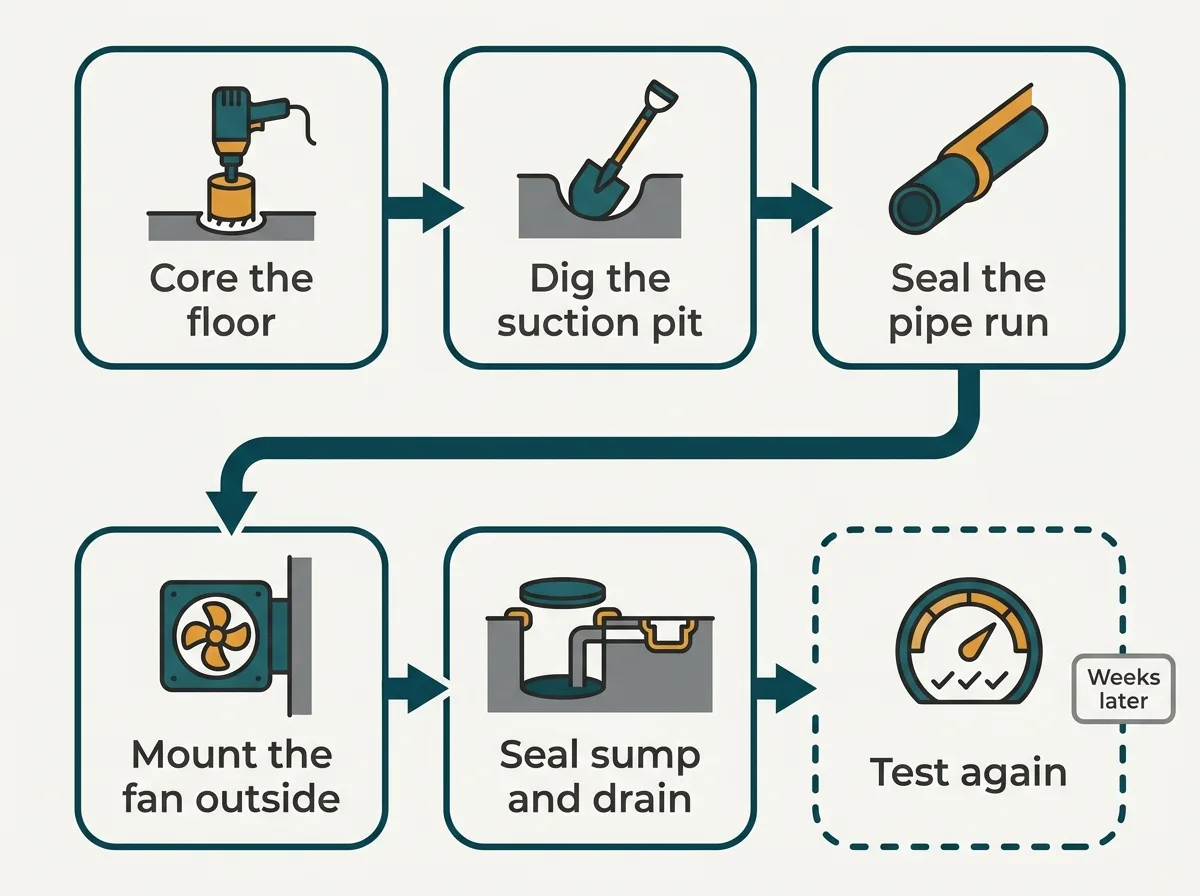
Most single family retrofits are a one day job. The crew cores a hole through the basement floor, usually somewhere unobtrusive along an exterior wall, and digs out a pit beneath it by hand. That pit is the part that decides whether the system works, because it is what lets the suction spread sideways under the whole slab instead of pulling from one small spot.
The pipe goes in next, sealed at every joint, and runs either up through the house to the roof or out through the rim joist and up the outside wall. Then the fan is fitted outside the lived in space, wired to its own switched circuit, and the discharge is finished above the roofline and clear of windows and air intakes.
Sealing follows: the sump lid, the floor drain, the slab perimeter joint where it is accessible, and any significant cracks. Last comes the manometer on the pipe and a walk through of what its reading should look like.
What does not happen on install day is proof. The house needs to settle back into its normal running state and then be measured again over a long enough period to mean something. That is the item to confirm is in the quote, because the work is not finished until a measurement says so.
Before you request a quote at all
The order matters, because a quote is only meaningful after a proper measurement.
A short screening reading cannot justify a $3,000 system, and it cannot rule one out either. What justifies the spend is a long term test of at least three months including the heating season, taken in a room people use. That process is set out in how to test a home for radon in the GTHA, and what the resulting number means is in what the 200 Bq/m3 guideline actually means.
With a real number in hand, ask for at least two written quotes, compare them on the five items above rather than on the total, and expect the system to be designed to get the house well below 200 Bq/m3 rather than just under it. Health Canada's guidance is to reduce the level as low as reasonably achievable, and the labour cost of aiming lower is usually nil.
The companies in this index that name mitigation work are on the radon mitigation contractors page. There are 12 of them, out of 35 records in total, which is a small directory rather than a complete picture of the trade in the Greater Toronto and Hamilton Area.
Frequently asked questions
What should a radon mitigation quote include?
- The number and location of suction points, the pipe route, the fan model and where it will be mounted, the sealing work included, and whether a post mitigation test is part of the price. RenoQuotes notes not every quote includes that test, so ask.
Why is one quote twice another?
- Usually because the two describe different systems. One suction point with an accessible exterior run sits at the bottom of every published range, while mixed foundations, crawl spaces, several slabs or an awkward pipe route move a job into the $4,000 to $10,000 and up band RenoQuotes publishes for complex installations.
Does the contractor have to be certified?
- C-NRPP certification is the Canadian credential to ask about, and it is a sensible floor for work at this cost. RadonIndex records certification claims made in a company's own website text and verifies none of them, so confirm any claim against the C-NRPP's own directory.
Should the system be guaranteed to get below 200 Bq/m3?
- Ask what target the design is built around and what happens if the post work test misses it. Health Canada asks for levels to be reduced as low as reasonably achievable rather than to the guideline exactly, and a system aimed well below the guideline generally costs the same to install.
Does RadonIndex recommend a mitigation company?
- No. This site publishes what a company says about itself on its own website, along with the wording that decided each call. It certifies nobody, endorses nobody, and takes no payment for position.