What the 200 Bq/m3 Radon Guideline Actually Means
Last updated: By RadonIndex Research Team
What the number is a measurement of
The Canadian guideline for radon is 200 becquerels per cubic metre. A becquerel is one radioactive decay per second, so 200 Bq/m3 means roughly two hundred decays every second in every cubic metre of air in the room.
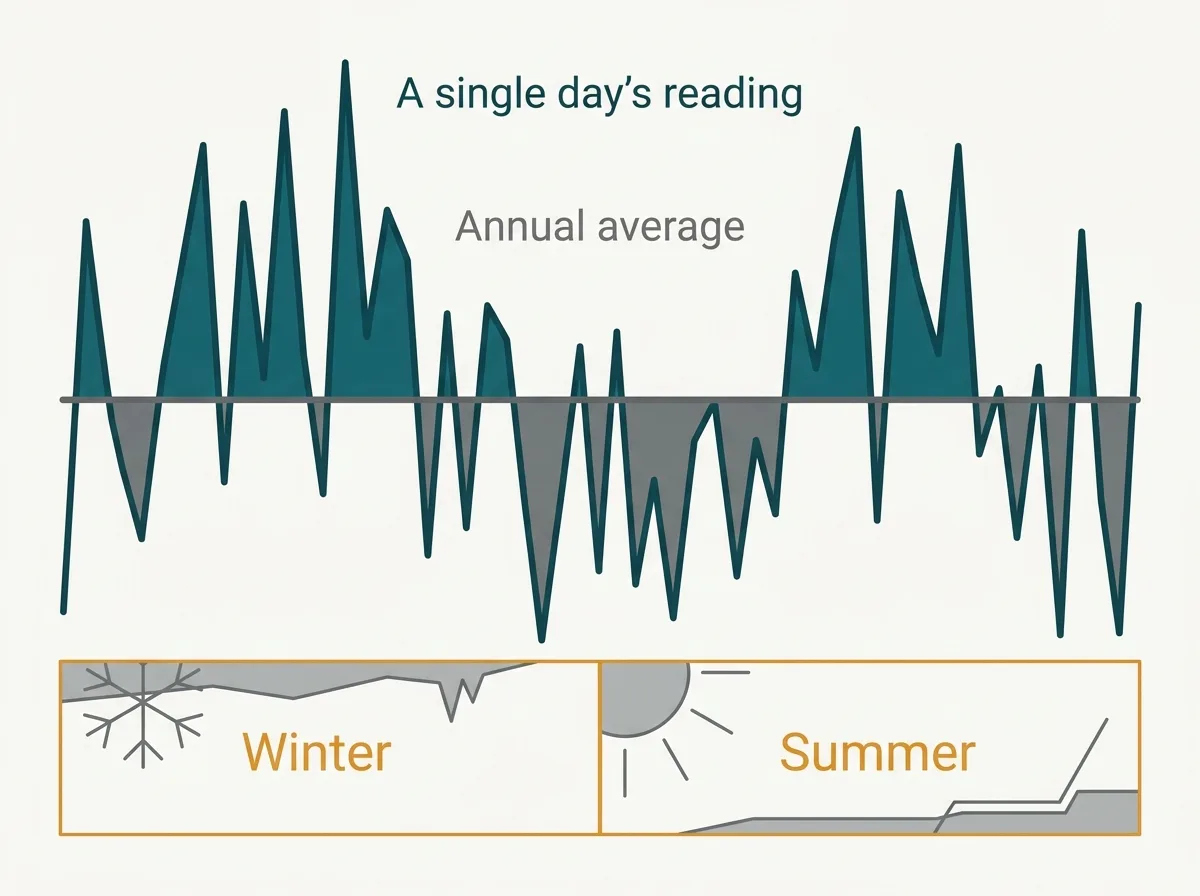
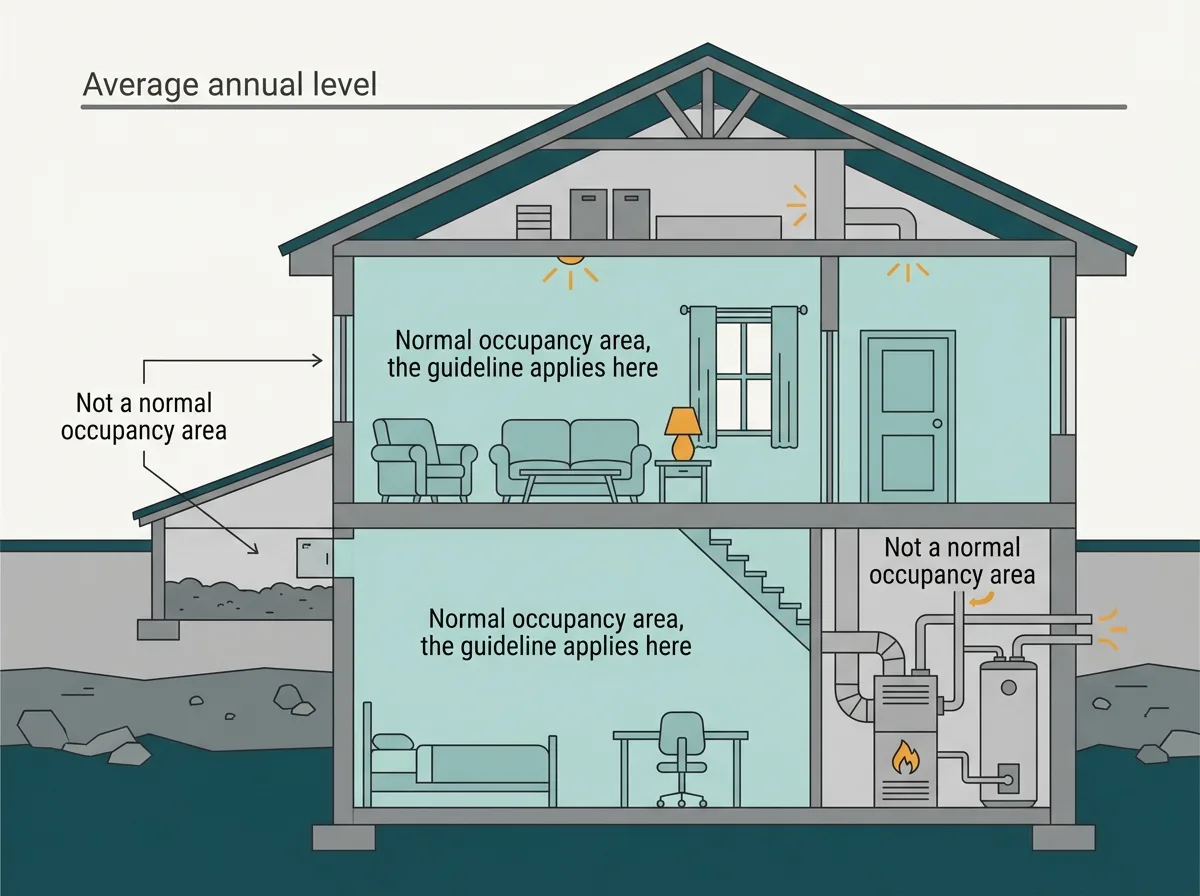
The part people skip is the wording around the number. Health Canada applies the guideline to the average annual radon level in the normal occupancy area of a building. Both halves of that phrase are doing work. Average annual rules out any single reading, because radon rises and falls with the weather, the season and how the house is being run. Normal occupancy area rules out the crawl space and the unfinished furnace corner, because the guideline is about the air people actually breathe.
This is why the measurement guidance and the guideline fit together as one instruction rather than two. A number that is not an average over months cannot be compared to the guideline at all, which is the whole argument in how to test a home for radon in the GTHA. A three day reading of 240 does not mean the house is above the guideline, and a three day reading of 90 does not mean it is below.
What Health Canada asks you to do above it
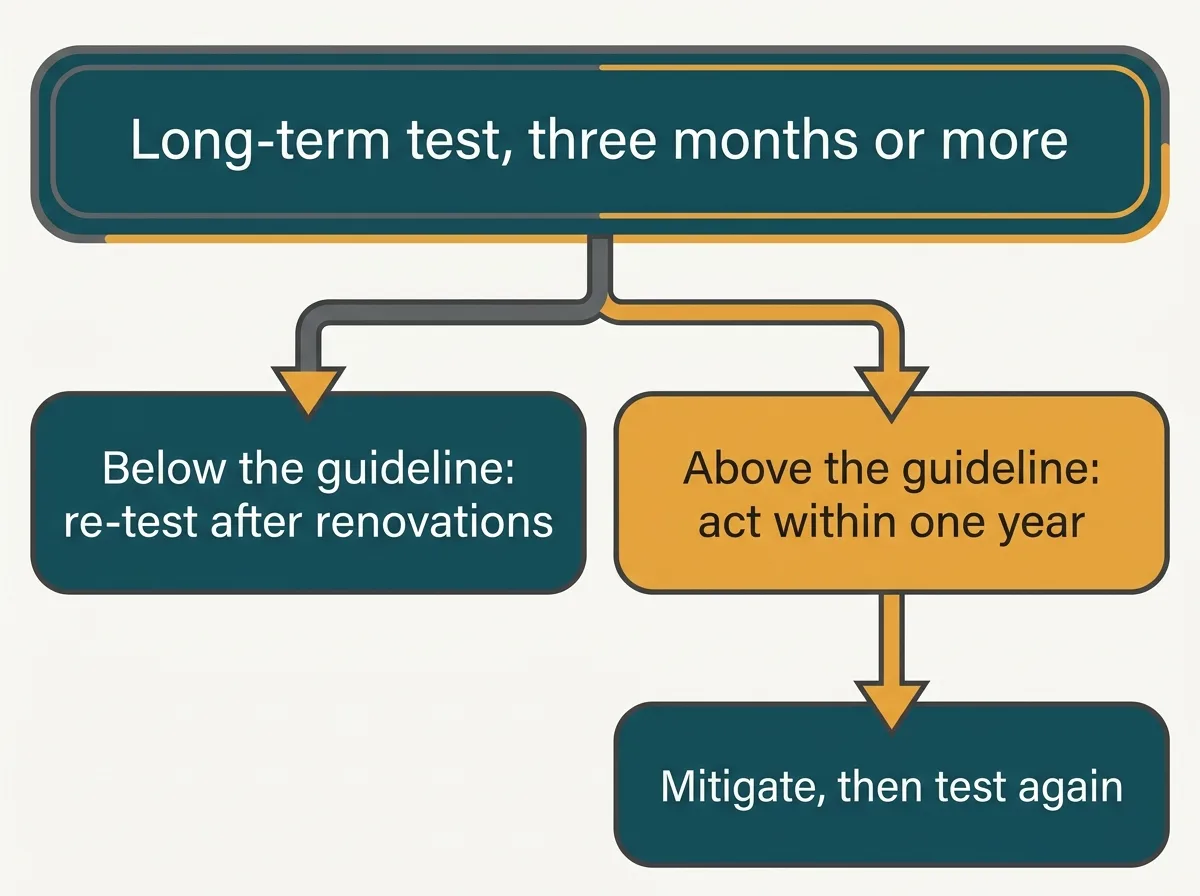
Health Canada's position is that corrective action should be taken within one year when the average annual level exceeds 200 Bq/m3, and that action should come sooner the higher the level is. Where work is done, the aim it sets is to bring the level as low as reasonably achievable rather than to land just under the line.
That last point is the practical one. A mitigation system designed to reach 199 Bq/m3 has met the guideline and has done almost nothing for the risk, and it leaves no margin for the years when the reading drifts up. A system designed to get a house well under the guideline costs the same to install, because the cost is in the pipe, the fan and the labour rather than in the target.
If your reading is above the guideline, what you would be buying is described in how a radon mitigation system works, and the published price ranges are on our radon mitigation cost guide.
Why it is not a safety line
A guideline reads like a boundary between safe and unsafe. Radon does not work that way, and Health Canada does not describe it that way.
Health Canada's own framing is that the health risk from radon exposure below the Canadian guideline is small, and that there is no level considered risk free. Risk falls continuously as the level falls, which means the difference between 190 and 120 is real even though both sit under the guideline. The World Health Organization sets its reference level lower still, at 100 Bq/m3.
So the guideline is best read as the point at which a national health agency thinks the balance of cost and benefit clearly favours doing the work, not as the point where harm begins. A household that lands at 150 and decides to mitigate anyway is not being irrational, and a household that lands at 150 and decides to leave it is not being reckless. Both are making a judgement about a risk that changes smoothly, with a number in hand.
What neither household should do is treat the number as permanent. Renovations, a new heating system, replacement windows and a finished basement all change how air moves through a building, and each is a reason to measure again.
How common it is to be above the guideline
Health Canada's Cross-Canada Survey of Radon Concentrations in Homes is the largest Canadian dataset on this question. It collected 13,807 valid long term results from alpha track detectors, with an average test length of 95.6 days.
Across the country, the survey found 6.9 per cent of Canadians living in homes above 200 Bq/m3. The population weighted estimate for Ontario was 4.6 per cent. That is the number worth carrying around: in this province, roughly one home in twenty is above the guideline, which is not most homes and is not a rare event either.
The averages also hide a lot. The same survey reported that 13 of 36 health regions, more than a third, had over 10 per cent of tested homes above the guideline. Radon comes out of the ground, and the ground is not uniform. Neither is housing stock: two houses of the same age on the same street can differ by a factor of several, because what matters is the foundation, the openings through it and how strongly the building pulls air up from below.
That is the reason there is no map that answers this question for your address, and the reason RadonIndex does not publish one. A regional percentage tells you how worthwhile testing is. Only a test tells you about your house.
Why the guideline exists at all
Radon is a decay product of uranium in soil and rock. Outdoors it disperses to almost nothing. Indoors it can accumulate, and what it leaves behind when it decays are short lived radioactive particles that lodge in lung tissue.
Health Canada describes radon as the leading cause of lung cancer among people who have never smoked, and the second leading cause after smoking overall. It attributes about 16 per cent of lung cancer deaths in Canada to radon exposure, which works out to more than 3,000 deaths a year in its published figures.
Risk also multiplies rather than adds for smokers. A smoker living in a high radon home carries a considerably greater risk than either exposure alone would suggest, which is why Health Canada publishes radon material aimed specifically at people who smoke.
None of that is a reason for alarm about a house nobody has measured. It is the reason the measurement is worth the three months and the $30 to $60 that a long term kit costs per Homeowner.ca. The gas is invisible, has no smell, and produces no symptom you could notice at home. A detector is the only way anyone finds out either way.
Reading your own result honestly
Three questions settle what a result means.
First, is it an average over at least three months, with the heating season included? If not, it is a screening number and it cannot be compared to the guideline.
Second, was the detector in a room people use, on the lowest lived in level, off the floor and away from the walls? A number from the furnace room is a number about the furnace room.
Third, was the house being run normally for the whole period? A test conducted through a renovation, an empty month or an unusually mild winter is a test of those conditions.
If the answer to all three is yes, then the guideline applies as written: above 200 Bq/m3, Health Canada asks for the work to be done inside a year. Below it, you have a real number, a small residual risk and a reason to test again after the next thing that changes how the house breathes. Where the gas gets in, and why two similar houses differ, is covered in where radon gets into a Toronto home.
Frequently asked questions
Is 200 Bq/m3 a safe level?
- No. Health Canada says the risk below the guideline is small but that no level is risk free, and the World Health Organization uses a lower reference level of 100 Bq/m3. The guideline marks where action is clearly worthwhile, not where harm starts.
My reading was 210. How urgently do I need to act?
- Health Canada asks for corrective action within one year for a home above the guideline, and sooner as the level rises. Before booking work, check that the 210 came from a test of at least three months including the heating season, in a room people use, because a shorter reading cannot be compared to the guideline.
How many Ontario homes are above the guideline?
- Health Canada's Cross-Canada Survey of Radon Concentrations in Homes gives a population weighted estimate of 4.6 per cent for Ontario, against 6.9 per cent nationally, from 13,807 valid long term results. More than a third of the health regions surveyed had over 10 per cent of homes above the guideline.
Does a low reading mean my neighbour's house is fine too?
- No. Radon levels depend on the foundation, the openings through it and how air moves through that specific building, so two similar houses on one street can return very different numbers. Every home has to be measured on its own.
How much does radon raise the risk of lung cancer?
- Health Canada attributes about 16 per cent of lung cancer deaths in Canada to radon and calls it the leading cause of lung cancer among people who have never smoked. It also notes the risk is considerably higher for smokers, because the two exposures compound.