How a Radon Mitigation System Works
Last updated: By RadonIndex Research Team
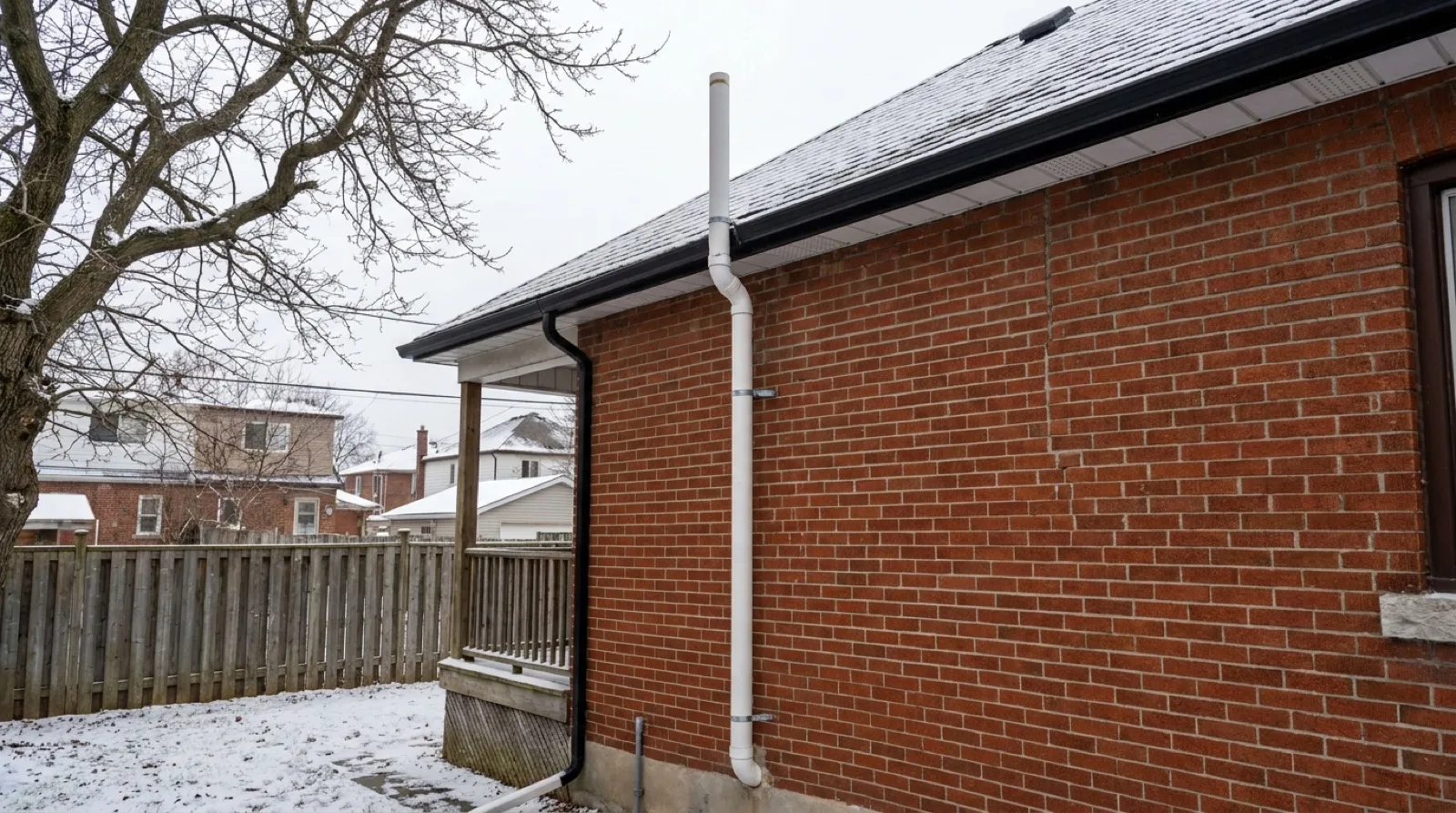
The problem is pressure, not the gas
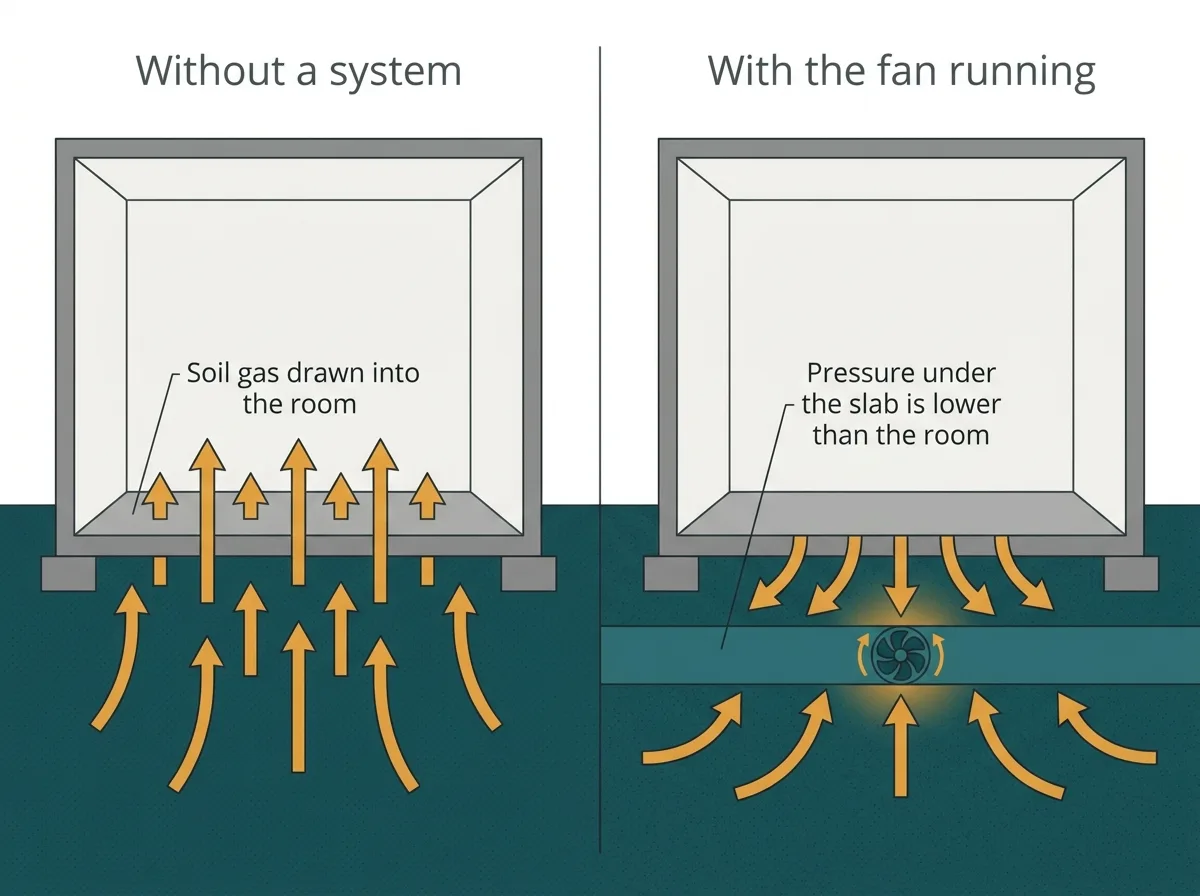
A heated house in an Ontario winter is a chimney. Warm air rises and leaks out at the top, cooler air is drawn in at the bottom to replace it, and the lowest level of the building sits at a slightly lower pressure than the ground around it. Soil gas takes the path that pressure difference opens for it, which is any gap in the floor slab, the joint where the slab meets the wall, the sump, the floor drain, or the sleeve around a service pipe.
That is the mechanism a mitigation system attacks. It does not filter radon out of the air and it does not neutralise it. It changes which way the pressure points, so the soil gas under the house never gets into the house at all.
Understanding that one idea explains almost every design decision that follows: why the pipe is sealed all the way through, why the fan runs continuously rather than on a timer, why the discharge has to be above the roof and away from windows, and why patching visible cracks alone is a poor substitute. The routes the gas uses are covered in more detail in where radon gets into a Toronto home.
What the parts do
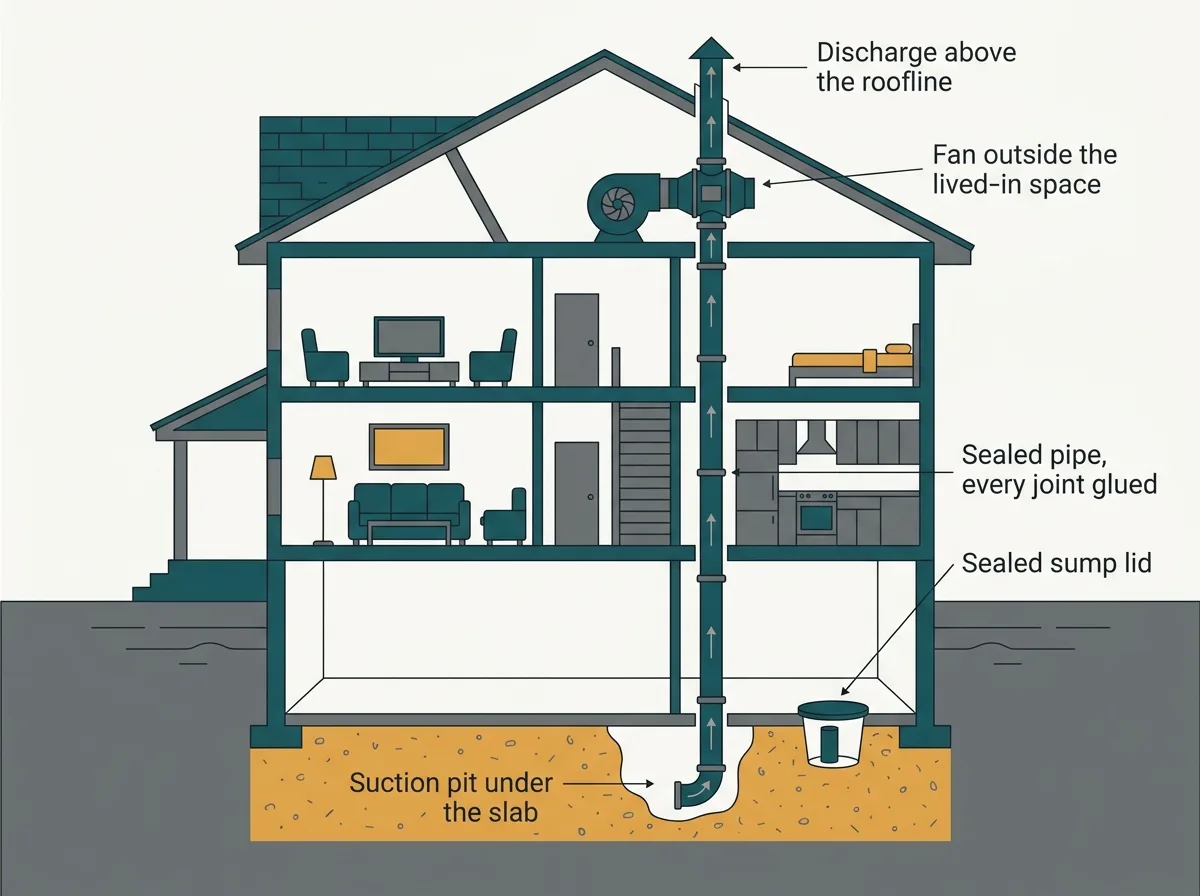
A sub slab depressurization system has four working parts and very little else.
In a new Ontario house permitted under the 2024 building code, the first two of these are partly built already, as a capped and labelled rough-in waiting for a fan: see what the radon rough-in in a new Ontario home does.
The suction point is a hole cored through the basement floor with a pit dug out beneath it. The pit matters more than the hole: it gives the fan a volume to draw from, so the suction spreads sideways through the gravel or fill under the whole slab rather than pulling from one spot.
The pipe is sealed rigid plastic running from that pit to the outside. Every joint on it is glued, because a leak in the pipe is a place where the fan pulls room air instead of soil gas and the suction under the slab falls.
The fan is an inline unit sized for the resistance of that particular floor. It is mounted outside the lived in space, so that if the pipe ever leaks on the pressurised side of the fan, it leaks outdoors and not into a bedroom. It runs all the time, because the pressure difference it is fighting is there all the time.
The discharge point is above the roofline, positioned so the gas disperses outdoors and does not find its way back in through a window or an intake.
The fifth part is not mechanical: sealing. The obvious openings, the sump lid, the floor drain trap, the slab perimeter joint and any large cracks, are sealed so the fan is pulling on the soil rather than on the basement.
How you know it is running
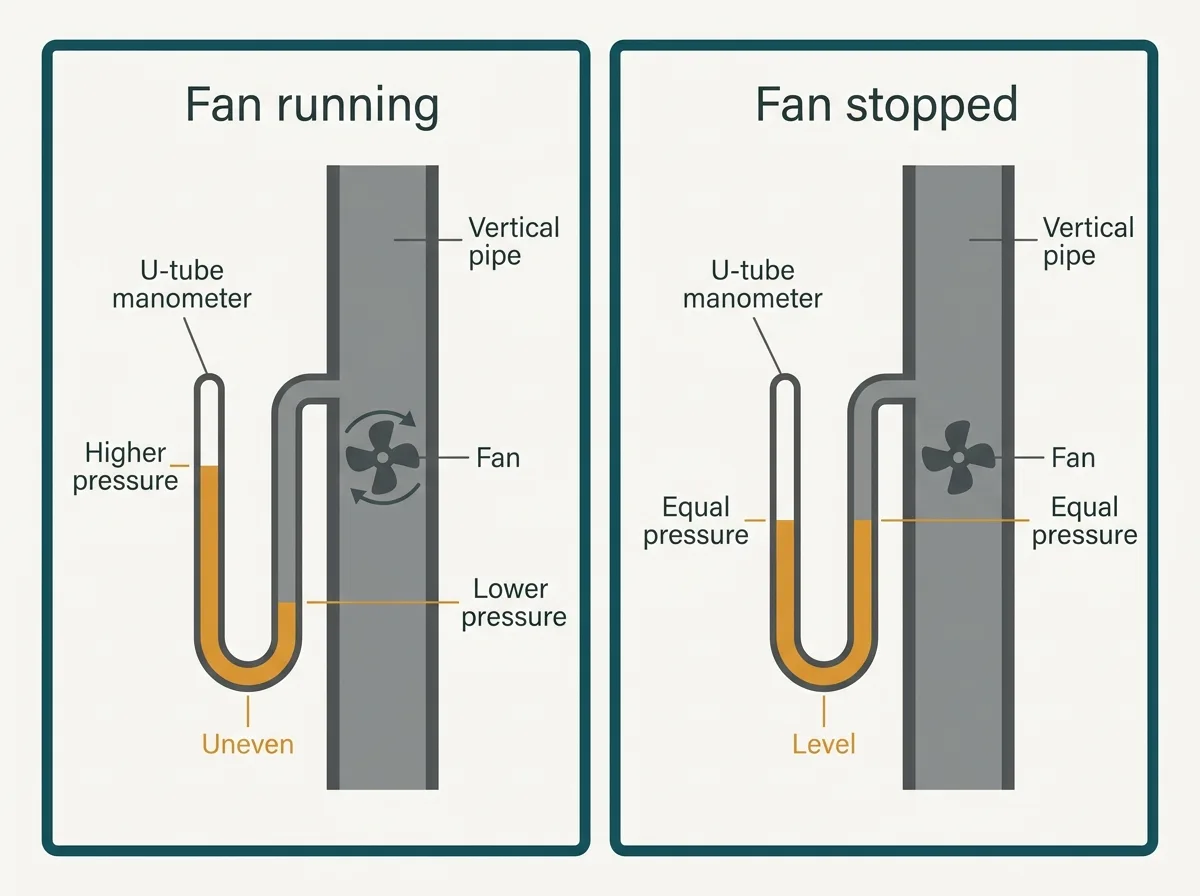
A radon fan is quiet and the gas is invisible, so a working system and a dead one look identical from the kitchen. Two things fix that.
The first is a manometer, a small U shaped tube of coloured liquid fitted to the pipe. When the fan is pulling, the liquid sits at different heights in the two legs. When it levels out, the system has stopped doing its job, and that is a five second check anyone can make from the basement stairs. Ask for one on the system and ask what the reading should look like on the day it is commissioned.
The second is a test after the work. A system that has never been measured under real conditions is an assumption with a fan attached. A post mitigation measurement, run properly, is the only thing that turns the install into a result, and it is the check most worth insisting on. There are two of them rather than one, and a retest interval after that: proving a radon system actually worked sets out what Health Canada asks for. Fans do fail eventually. Homeowner.ca puts a replacement fan at $200 to $300 for the part, plus installation labour if you are not fitting it yourself.
No source we could verify publishes a Canadian figure for what a radon fan costs to run each year, so we do not print one. Ask the installer for the fan's wattage and do the arithmetic against your own electricity rate.
What it costs, and where the range comes from
Every figure here is a published Canadian range, not a quote from any company in this index. We hold no pricing from mitigators in the Greater Toronto and Hamilton Area and we do not estimate one.
Homeowner.ca reports the Health Canada Reduction Guide range for sub slab or sub membrane depressurization at $2,000 to $3,000 for material and labour, assuming a single suction point and accessible routing. The same source puts a typical Canadian mitigation system at $2,000 to $4,000 installed, with a national average near $2,900.
RenoQuotes publishes bands by system type: $2,000 to $4,500 where a sump or drain tile can be safely sealed and used as part of the system, $3,000 to $6,000 and up for crawl space sub membrane work, and $4,000 to $10,000 and up for complex or multi system installations. Large homes, several foundations, a difficult venting route or very high readings are what move a job into that last band.
The whole table, with the source and the condition attached to each row, is on our radon mitigation cost guide. Ontario adds HST on top, and new homes in this province carry radon coverage under the Tarion warranty, which can make mitigation the builder's responsibility. Confirm the current terms with Tarion directly rather than assuming it applies to you.
The fixes that do not work on their own
Three cheaper ideas come up constantly, and all three have the same shape: they help a little, and none of them replaces a system.
Sealing every crack is the first. It is close to impossible to find and seal every opening in a floor slab, and the ones you miss simply carry more of the flow once the others are closed. Sealing is a real part of a mitigation system, done alongside the fan rather than instead of it.
Ventilation is the second. Homeowner.ca prices an HRV or ERV at $1,500 to $3,500 for material and labour, and rates it at a 25 to 50 per cent reduction against 80 per cent or better for active depressurization. It also adds ongoing electricity and heating cost. In a house that is somewhat above the guideline it can be part of an answer, particularly where you want the ventilation anyway. In a house that is well above, it is not the answer.
Opening windows is the third. It works while the windows are open, in the season when nobody opens them, and stops working the moment they close. Radon exposure is an annual average, so an intervention that runs three months of the year moves the number that matters far less than it feels like it should.
What separates a good quote from a bad one, including who is entitled to claim certification, is set out in how to read a radon mitigation quote.
Who does this work in the GTHA
RadonIndex is a small directory and says so. The index holds 35 company records, of which 12 name radon mitigation on their own website and 31 name testing. A company can be counted in both.
We list a company when its own website evidences radon work, and we publish the wording that decided the call. We do not verify certification, we do not rank anyone by what they paid, and no company in this index set the prices above. Four of the 35 records carry a C-NRPP style certification claim in their own site text, which we record as a claim and nothing more. Certification is worth checking directly against the Canadian National Radon Proficiency Program's own directory before you sign anything.
The companies are listed on the radon mitigation contractors page, and how records get in and why 103 of the 138 businesses in the original sweep were dropped is documented on our methodology page.
Frequently asked questions
What is sub slab depressurization?
- A sealed pipe running from a pit dug under the basement floor to a continuously running fan that discharges above the roofline. It holds the space under the slab at a lower pressure than the room, so soil gas travels up the pipe instead of through the floor.
Does the fan have to run all the time?
- Yes. The pressure difference that draws soil gas indoors is present whenever the house is heated, so a fan on a timer leaves the house unprotected for the hours it is off. Radon exposure is judged as an annual average, which is what an intermittent system fails.
How much does a radon mitigation system cost in the GTHA?
- No published figure is specific to the Greater Toronto and Hamilton Area, so we do not print one. The Canada wide ranges are $2,000 to $3,000 for a standard sub slab system under the Health Canada Reduction Guide range as reported by Homeowner.ca, and $2,000 to $4,000 installed with a national average near $2,900. Get at least two written quotes.
Will sealing the cracks in my basement floor be enough?
- Rarely. It is close to impossible to find and seal every opening in a slab, and the openings you miss carry more of the flow once the rest are closed. Sealing is part of a mitigation system rather than a replacement for one.
How do I know the system is still working?
- Ask for a manometer on the pipe, note what it reads on commissioning day, and check it occasionally. A level reading means the fan has stopped. Beyond that, re test the house periodically, since the only real proof is a measurement.