How to Test a Home for Radon in the GTHA
Last updated: By RadonIndex Research Team
Why a radon number takes three months
Radon is a soil gas that seeps into a building through the ground floor, and how much of it is indoors at any moment depends on the weather, the wind, whether the furnace is running and whether a window is open. A reading taken on a Tuesday afternoon in July describes a Tuesday afternoon in July. It does not describe the house.
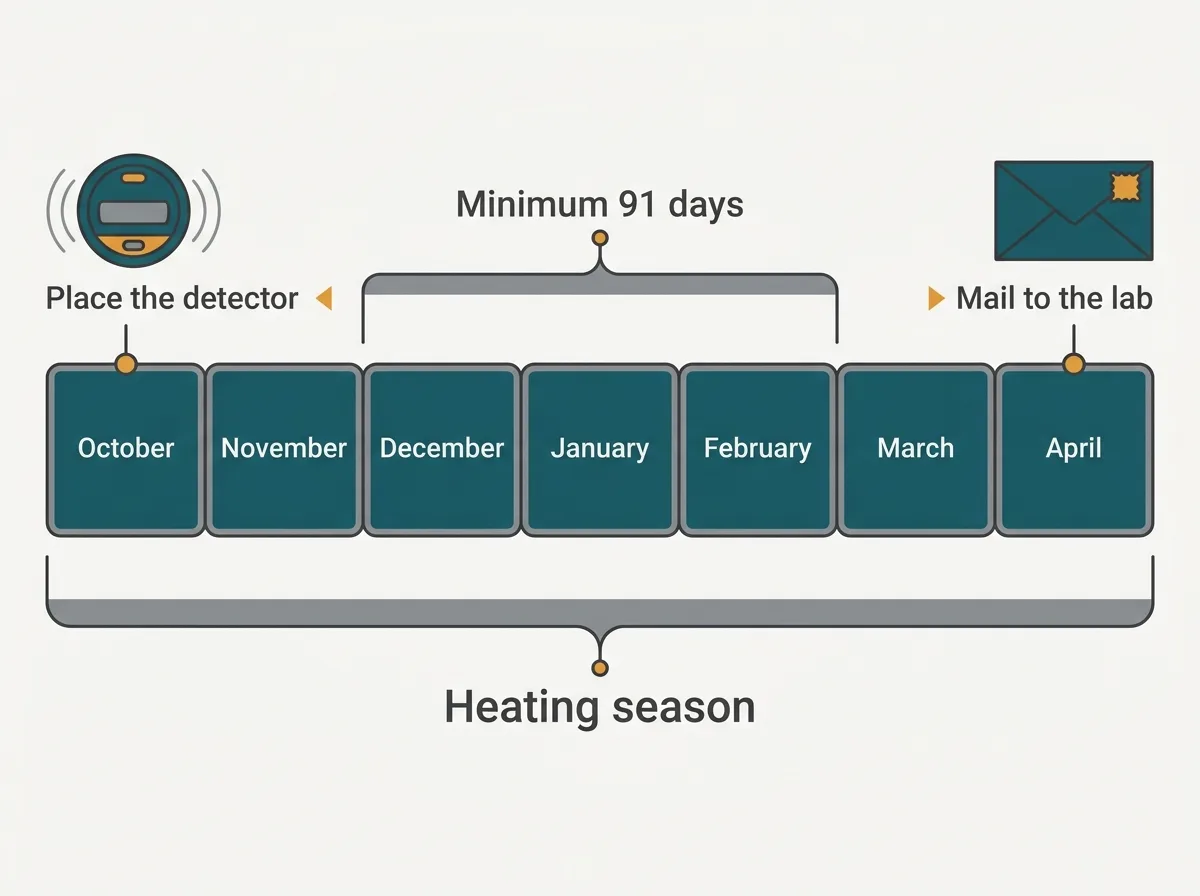
That is why the Canadian guideline is written as an annual average rather than a spot reading, and why Health Canada's Guide for Radon Measurements in Residential Dwellings asks for a test that runs three to twelve months, with a minimum of 91 days of the test falling in the heating season. Winter is the demanding case: the house is sealed, the heating system is pulling air upward, and the pressure difference that draws soil gas indoors is at its strongest.
The scale of that guidance is not theoretical. Health Canada's Cross-Canada Survey of Radon Concentrations in Homes collected 13,807 valid results using long term alpha track detectors, and the average test in it ran 95.6 days with a median of 92. The survey found 6.9 per cent of Canadian homes above the guideline, and a population weighted estimate of 4.6 per cent for Ontario.
So the honest sequence is slow and cheap: put a detector in the right room in the autumn, leave it alone through the winter, mail it to the lab in the spring, and read the number it returns. Everything else on this page is detail around that one instruction.
Where the detector goes
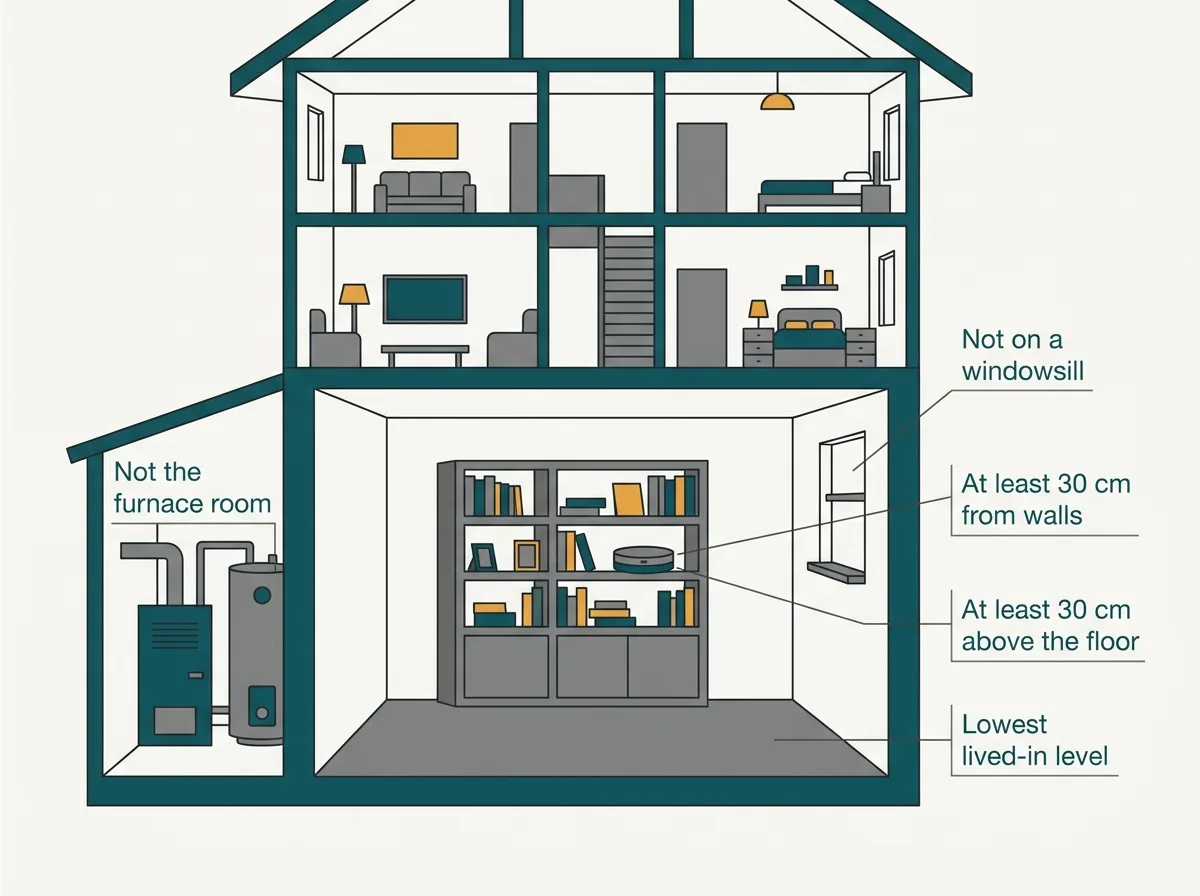
Health Canada's measurement guide is specific about placement, and the specifics matter more than most people expect. The detector belongs in a room on the lowest level of the home that has a normal occupancy area: a bedroom, an office, a playroom, a living room in a basement or on the main floor. The test is meant to measure the air people breathe, not the worst corner of the building.
Within that room, the guide asks for the typical breathing zone, at least 30 cm above the floor, and at least 30 cm away from walls and ceilings. A shelf or a table works. The floor does not, and neither does a windowsill, a cupboard, the top of the furnace or anywhere with a draft, direct sun or high humidity.
The unfinished furnace room is the classic mistake. It usually reads higher than the rest of the basement, which feels like the cautious choice, but it is not a room anyone lives in, so the number it produces is not the number the guideline is written about. If the basement is finished and used, test the finished part.
One more rule that costs nothing: run the house normally for the whole test. No propping doors open, no shutting the heating down, no sealing anything in advance. A test conducted during an unusual three months answers a question about an unusual three months.
What a test costs, and what you get for the money
There are two routes, and they answer slightly different questions.
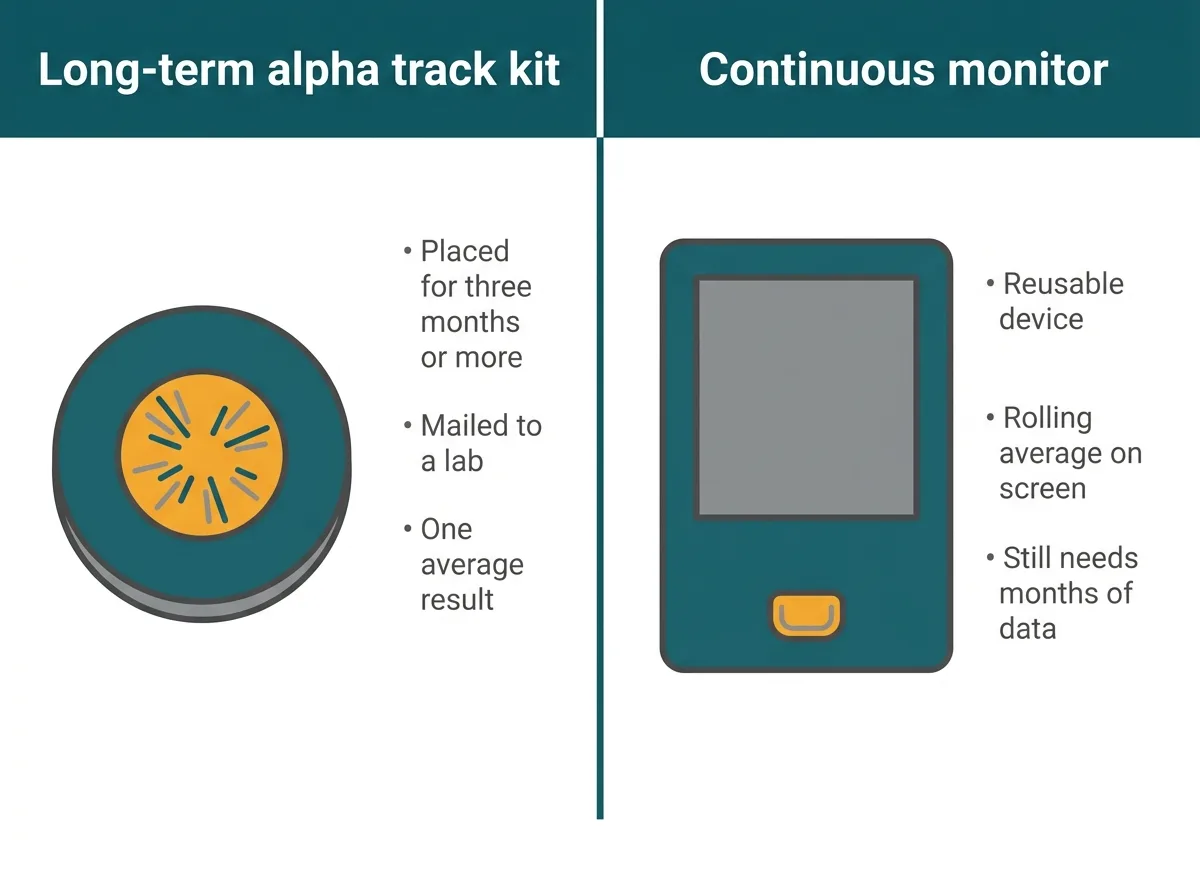
A long term alpha track kit is a small plastic detector you place, forget, and mail to a lab. Homeowner.ca puts these at $30 to $60 per kit including the lab analysis. The Evict Radon National Study, a Canadian university led project, sells an at cost kit for $53.99 and adds your result to its research dataset. Either way you get one number covering the whole placement period, which is exactly the measurement the guidance is built around.
A consumer continuous radon monitor is a reusable device that reports a rolling average on a screen. Homeowner.ca prices these at $200 to $350. The advantage is that you can move it around the house, watch what happens when the weather changes, and re check a level after work is done. The limitation is the same one as any short reading: the device still needs months of data before its average means anything for a mitigation decision.
The full price table, with every row traced back to the source it came from, is on our radon testing cost guide. What is not on that page is a price for professional placement in the Greater Toronto and Hamilton Area, because no source we could verify publishes one. Ask a company directly and get the figure in writing. Which suppliers actually sell kits in this province, including the list Take Action on Radon maintains, is in where to get a radon test kit in Ontario.
When a short test is the right test
Short tests are not useless. They are screening tools, and they are honest when they are described that way.
A two day or seven day reading can tell you that a house is dramatically high and worth acting on quickly, or that a mitigation system that was running yesterday has stopped working today. What it cannot do is justify spending thousands of dollars, because a low short reading does not rule out a high annual average and a high short reading may be a windy week rather than a problem.
A real estate transaction is the awkward case, because nobody has three months. Health Canada's own advice for that case is to run a long term test once you have moved in rather than to test during the transaction, and where a buyer wants protection before closing it points at a hold back rather than a rushed reading. If a short reading is taken anyway, paying a certified measurement professional is the way to do it: the protocol, the device and the report are theirs, and the result carries more weight in a negotiation than a kit somebody left on a bookshelf. The whole sequence, and what to ask about a house that already has a system, is in radon when you are buying a home in Ontario.
After mitigation, test again. A system that has never been measured under real conditions is an assumption with a fan attached, and a post work test is the only thing that turns it into a result.
Who does the measuring in the GTHA
RadonIndex is a small directory, and it is worth being plain about the size. The index holds 35 company records across the Greater Toronto and Hamilton Area. Of those, 31 name radon testing on their own website and 12 name mitigation, and a company can appear in both counts.
Those 35 came out of 138 businesses the sweep returned. The other 103 were dropped and the reason for each drop is published: 39 publish no website at all, so no evidence could be read; 22 had a website that could not be read; 26 have an address outside the Greater Toronto and Hamilton Area; 6 have neither an address nor a stated service area here; and the remaining 10 either sell products rather than services, name no radon service in their own words, or turned out to be a duplicate Google profile. That method, and its limits, is set out on our methodology page.
Twelve of the 35 publish no street address, so we can say what area they claim to serve and not where they are based. Four make a C-NRPP style certification claim in their own website text. RadonIndex records the claim and the sentence it appeared in. It does not verify certification, it does not endorse a company, and no business can pay for a better position. If certification matters to your decision, and for a measurement you intend to act on it should, check the Canadian National Radon Proficiency Program's own directory before you book.
The full list is on the radon testing companies page.
What to do when the result arrives
The lab sends back a number in becquerels per cubic metre. The Canadian guideline is 200 Bq/m3 as an annual average in the normal occupancy area of the home, and Health Canada asks for corrective action within a year when a home is above it, sooner as the reading gets higher.
Below the guideline is not the same as nothing. Health Canada is explicit that the risk below the guideline is small but that no level is risk free, and the World Health Organization uses a lower reference level of 100 Bq/m3. Risk falls continuously as the level falls, which is why a mitigation system is often set a target well under the guideline rather than just under it.
A result also has a shelf life. Renovations, a new basement floor, a change of heating system, new windows or a finished cold cellar all change how air moves through a building, and any of them is a reason to test again. So is buying the house from someone who tested it years ago.
What the number means, and what it does not, is covered in what the 200 Bq/m3 guideline actually means. If yours came back above it, how a radon mitigation system works explains what you would be buying.
Frequently asked questions
How long does a radon test have to run?
- Health Canada's measurement guide asks for three to twelve months, with at least 91 days of the test falling in the heating season. Radon swings hour to hour and season to season, so a short test describes a few days rather than a house.
Where should I put the detector?
- In a room on the lowest level of the home that someone actually uses, at least 30 cm above the floor and at least 30 cm from walls and ceilings, away from drafts, direct sun and humidity. The furnace room is the common mistake: it often reads higher, but nobody lives in it.
Is a cheap kit as good as a continuous monitor?
- For deciding whether to mitigate, yes. A long term alpha track kit at $30 to $60 per Homeowner.ca produces the multi month average the guidance is written around. A $200 to $350 continuous monitor is better for watching trends and for re checking after work, but the decision still rests on the long term average.
Do I need a certified professional to test my own home?
- Not for a first test. A do it yourself long term kit is a valid measurement. A certified measurement professional is worth paying for in a real estate transaction, in a commercial building, or where you intend to act on the result with a large spend.
Can I rely on a neighbour's radon result?
- No. Two houses on the same street can return very different numbers, because the result depends on the foundation, the openings in it and how air moves through that particular building. Health Canada's own survey found more than a third of Ontario health regions with over 10 per cent of homes above the guideline, which is a statement about regions and not about any one address.