Radon When You Are Buying a Home in Ontario
Last updated: By RadonIndex Research Team
What Health Canada actually recommends during a sale
Most people assume radon is something you test for before you close, alongside the home inspection. Health Canada's position is the opposite. Its guidance for real estate professionals states that Health Canada doesn't recommend conducting a radon test during a real estate transaction. The advice it gives agents instead is to "encourage clients to conduct a long-term radon test once they have moved into their new home".
That is not a shrug. It is a statement about what a short test can support. The same department's guide for radon measurements in homes says plainly that "short-term measurements are not appropriate for informing mitigation decisions", and that corrective action should be decided on "tests which are at least 91 days in length".
So the honest sequence for a buyer is: buy the house, then measure it properly through your first heating season, then decide. The guidance is not asking you to ignore radon. It is asking you not to make a five figure decision, or walk away from a house, on a number that cannot carry it.
Why a test does not fit inside a condition period
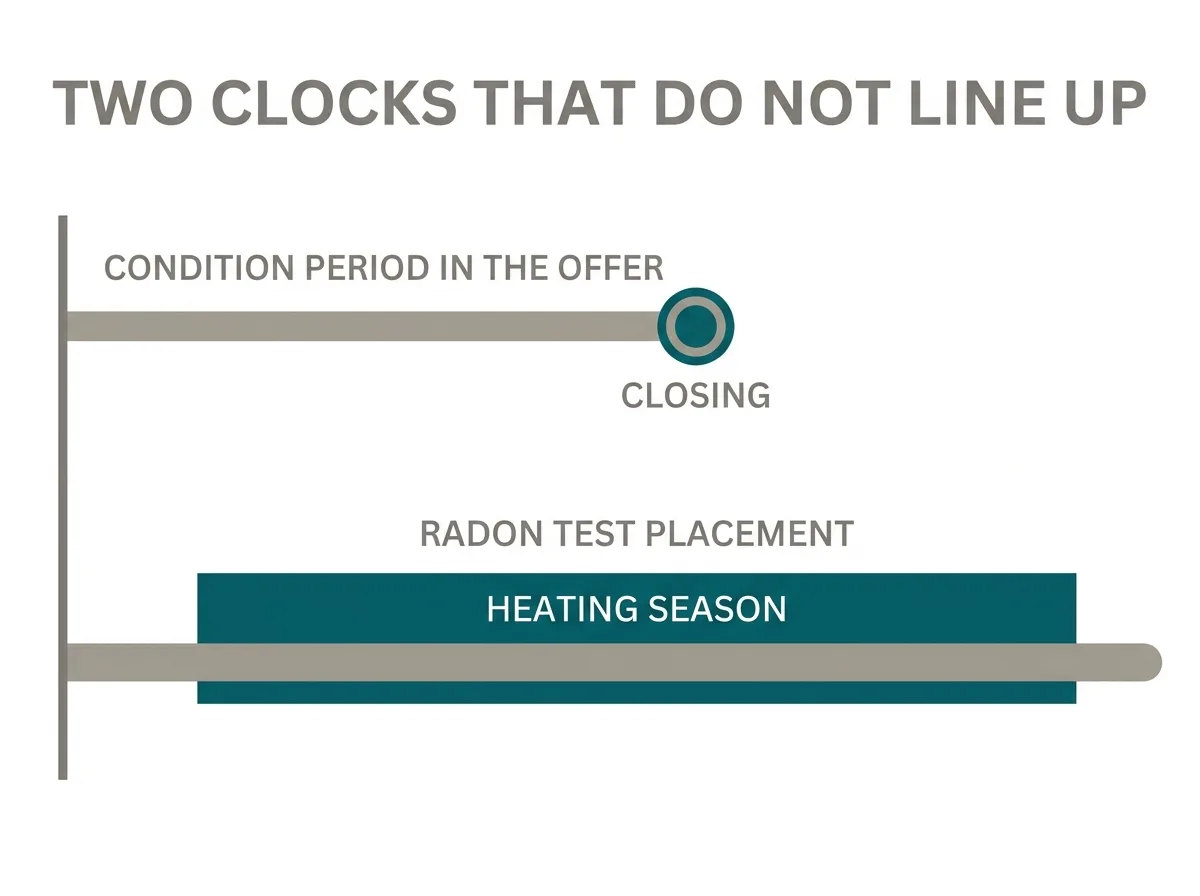
A radon level is not a fixed property of a house. It moves with the weather, with how the heating system is running, and with whether the doors have been open. That is why Health Canada's measurement guide asks for a test "over a period of 3 to 12 months", with "a minimum of 91 days of the test ... during the heating season". The number all of that is aimed at is the Canadian guideline, which asks for corrective action where "the average annual radon level exceeds 200 Bq/m3 in the normal occupancy area of a building". A becquerel per cubic metre, written Bq/m3, is the unit radon in air is measured in, and the normal occupancy area is the part of the home people actually live in.
An Ontario purchase agreement does not have a spare three months in it. Condition periods are counted in days. Even a generous one expires long before a detector has seen enough of the year to average anything meaningful.
The trap is that a short number still looks like a number. A low reading over a warm, breezy week does not tell you the annual average is low, and a high reading over a cold snap does not tell you the house is a problem. Either one can send a buyer to the wrong decision with complete confidence. Our guide on how to test a home for radon in the GTHA goes through what the measurement is actually doing and why the clock is so long.
The hold back, and what it has to say
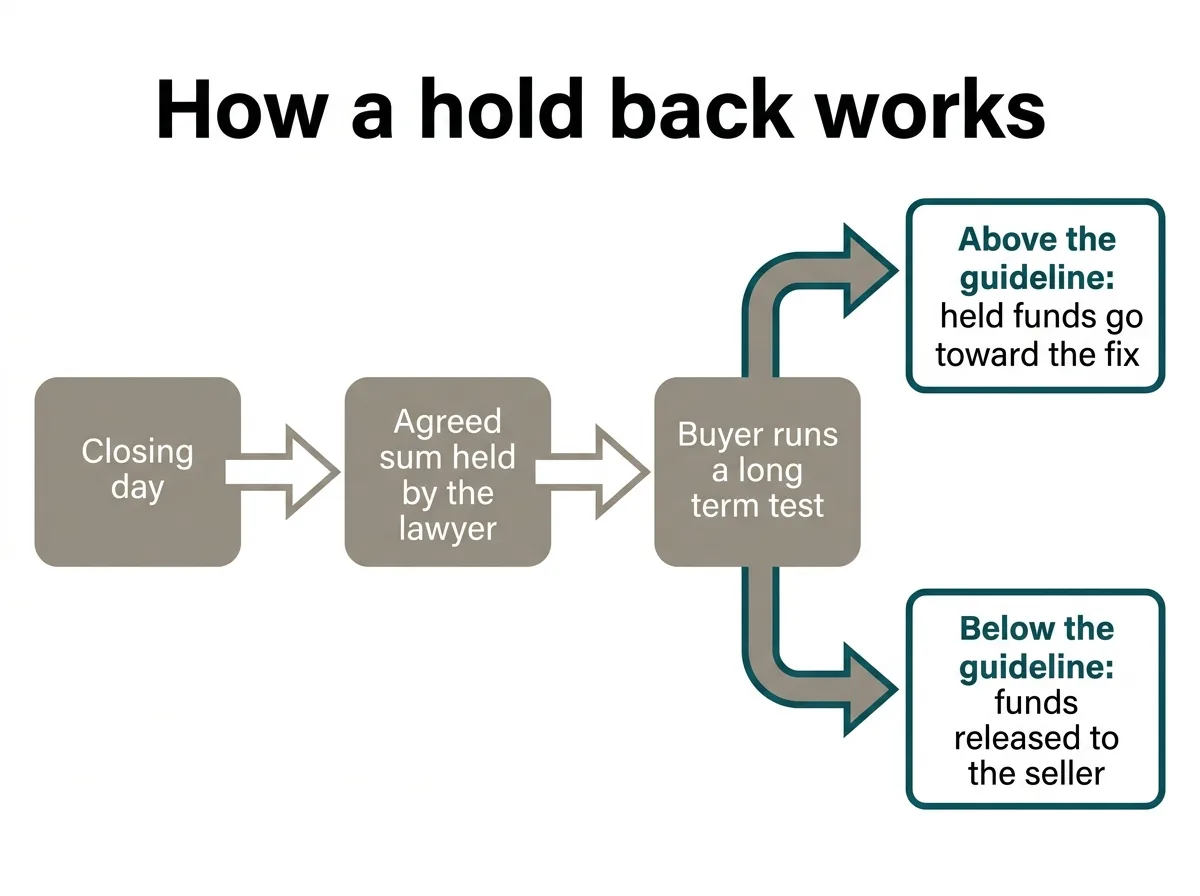
If you want the radon question settled and you still want the house, the instrument Health Canada names is a hold back. Its real estate guidance notes that "in some cases, real estate professionals are using a hold back to allow for radon testing after a transaction is complete".
The mechanics are ordinary conveyancing. An agreed sum stays with a lawyer after closing rather than going to the seller. The buyer runs a proper long term test in the house they now own. If the result comes back above the guideline, the held funds go toward the fix. If it comes back below, the money is released to the seller.
What makes or breaks the clause is how specific it is, and that is a conversation for your lawyer and your agent rather than for a directory. The questions worth taking to them: what result triggers it, who chooses the measurement, how long the buyer has to run the test, and what the money is actually sized against. On that last point, published Canadian ranges are the only honest anchor, and ours are collected on the radon mitigation cost guide with each row traced to the source it came from.
RadonIndex does not draft clauses and does not give legal advice. What we can tell you is that a hold back sized from a guess is the common failure, and a published range is better than a guess.
If the house already has a mitigation system
A radon system in the basement is a good sign and an unfinished question at the same time. It tells you a previous owner found a reason to install one. It does not tell you the level came down.
The document to ask for is the measurement taken after the system was switched on. Health Canada's reduction guide sets out what should have happened: "a certified C-NRPP professional carry out a short-term test after a system is activated to demonstrate that it is working effectively". C-NRPP is the Canadian National Radon Proficiency Program, the national scheme that certifies radon workers. The guide then asks for "a long-term three-month test ... the following fall /winter season to confirm that the annual average radon level has been reduced to below the Canadian guideline".
So there should be two pieces of paper, not one, and neither of them is the invoice. Ask as well when the fan was installed, whether it has been replaced, and whether anyone has read the pressure gauge on the pipe lately. A fan is a moving part in a system that fails silently. What to do about all of this once you own the house is in our guide on proving a radon system actually worked.
CARST, the Canadian Association of Radon Scientists and Technologists, adds one more thing for viewings and tests: "radon mitigation systems shall be operated as normal". A system switched off to make a basement quieter for showings is a system you are not measuring.
If you want some indication before you close
Health Canada's guidance points past closing, and that is the recommendation this site follows. But buyers do sometimes want a signal before they commit, and there is a named, documented way to take one rather than an improvised one.
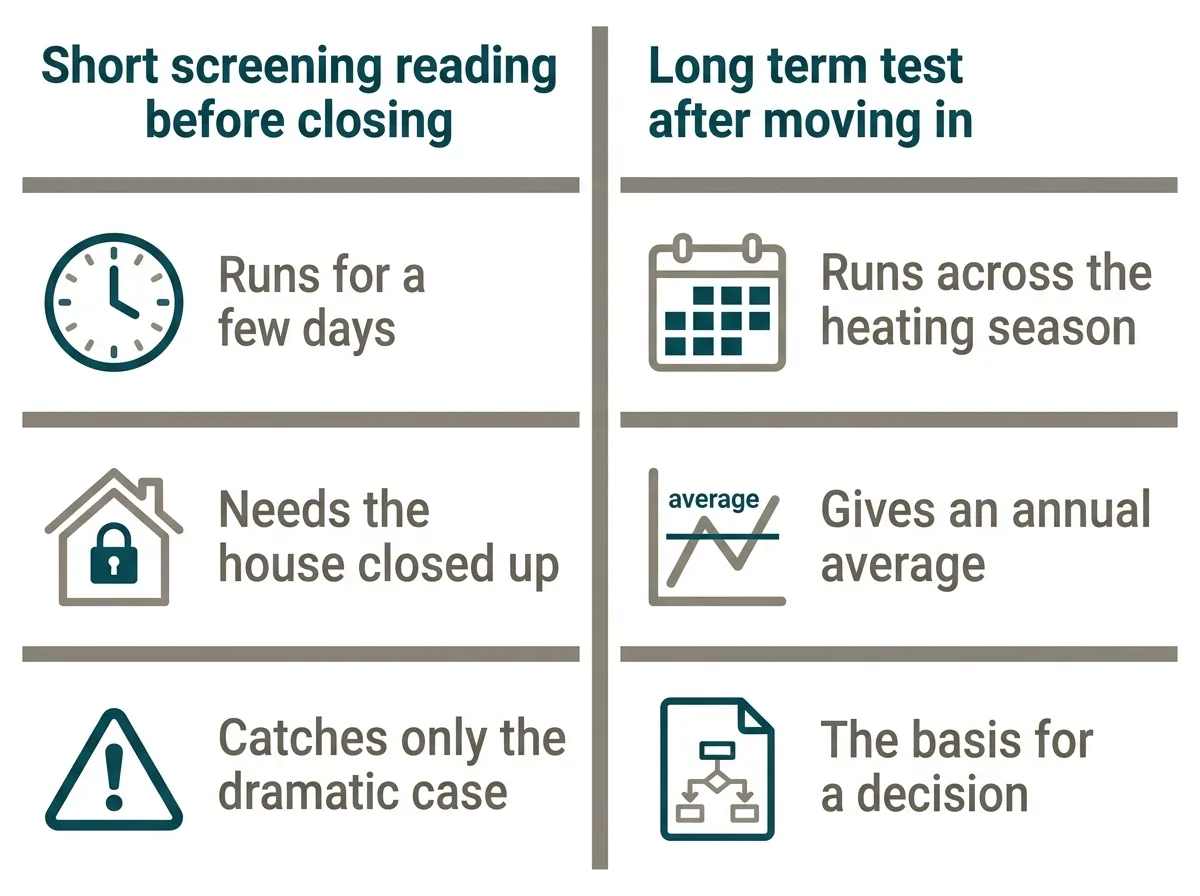
CARST states on its buying a home page that "if you aren't sure you want to purchase a test without some indication of the radon level, CARST has developed a guideline for conducting a Radon Screening Assessment". Its conditions are specific: "the detector must be in place for a minimum of 4 days", with "windows ... closed at all times" and external and attached garage doors "opened only for entry and exit".
Read what that is. It is a screening assessment, and CARST names it as one. Run under closed house conditions it gives you a defensible short reading rather than a meaningless one. It still does not give you an annual average, and it is still not the basis Health Canada asks decisions to be made on.
What a screening result is genuinely good for is catching the dramatic case, where a house is high enough that nobody needs three months to see it. Handled that way it informs a negotiation. Treated as a pass or fail certificate, it misleads.
What this directory can and cannot help with
RadonIndex holds 35 company records for the Greater Toronto and Hamilton Area, counted from our own listings data today. Of those, 31 name radon testing on their own website and 12 name mitigation.
Five of the 35 state a C-NRPP style certification claim in their own site text. We record the claim and the wording we found it in. We do not verify it, we do not certify anybody, and nobody can pay for a position here. If certification matters to your transaction, and Health Canada's reduction guide tells you to ask "can the contractor provide proof of C-NRPP certification?", then check it at the source rather than taking our word or theirs.
From here, radon testing companies is the list to start from for a measurement after you move in, and radon mitigation contractors is the list for the fix if your long term result comes back above the guideline. If you would rather describe the house once and have companies come back to you, there is a quote form.
Frequently asked questions
Is a radon test part of a home inspection?
- Not normally, and a standard home inspection does not include one. Some inspectors offer a short radon measurement as a paid add-on. Be clear about what you are buying. Health Canada's guide for radon measurements in homes says short-term measurements are not appropriate for informing mitigation decisions, so an add-on reading is a screening result rather than the number a decision rests on.
Should I test for radon during a home purchase?
- Health Canada's real estate guidance says it does not recommend conducting a radon test during a real estate transaction, and asks agents to encourage clients to run a long term test once they have moved in. If you want protection before closing, the instrument it names is a hold back rather than a rushed test.
What happens if a radon test comes back high during a home inspection?
- First, check what kind of test it was. A short reading over a few days is a screening result and not grounds on its own for walking away or for a large price reduction. It is a reason to raise the question with your agent and lawyer, to consider a hold back, and to plan a proper long term test after closing. Health Canada asks for corrective action above 200 Bq/m3 as an average annual level, which a few days cannot establish.
Who pays for radon mitigation when you buy a house?
- There is no rule that assigns it. It is negotiated, like any other repair, and the hold back Health Canada describes exists precisely because the answer is often "we will find out after closing". Published Canadian ranges for the work are on our radon mitigation cost guide, and going into that negotiation with a sourced range beats going in with a guess.
Does a radon mitigation system lower a home's value?
- We hold no Canadian resale data and will not invent a number for it. Health Canada's real estate brochure frames an installed system the other way around, telling sellers that testing and fixing before a sale lets a low radon level be presented as a feature of the home. What we can say from the guidance is that a system with its post-installation test results attached is worth more to a buyer than a system with only an invoice.