Radon in the Basement vs First Floor: Which Reading Counts
Last updated: By RadonIndex Research Team
Which floor's radon reading does Health Canada go by?
Health Canada goes by the lowest lived-in level of the home. Its Guide for radon measurements in homes says "All measurements should be made in a normal occupancy area of the lowest lived-in level of the home". Health Canada's guide defines that level as "the lowest level or floor of the home where someone spends 4 or more hours a day".
The reason is what the test is for. The same guide says "The goal of testing is to determine the average annual radon level in normally occupied areas of the home". Radon in air is measured in becquerels per cubic metre (Bq/m3). The Health Canada radon guideline asks for corrective action "if the average annual radon level exceeds 200 Bq/m³ in the normal occupancy area of a building". What that figure means is covered in the guide to the 200 Bq/m3 guideline.
What makes a basement a lived-in level?
A basement counts when someone uses it for hours on an ordinary day. The Health Canada radon guideline defines the normal occupancy area as "any part of the building where a person is likely to spend more than 4 hours per day". It includes a basement apartment and a finished basement with a family room, guest room, office or workshop.
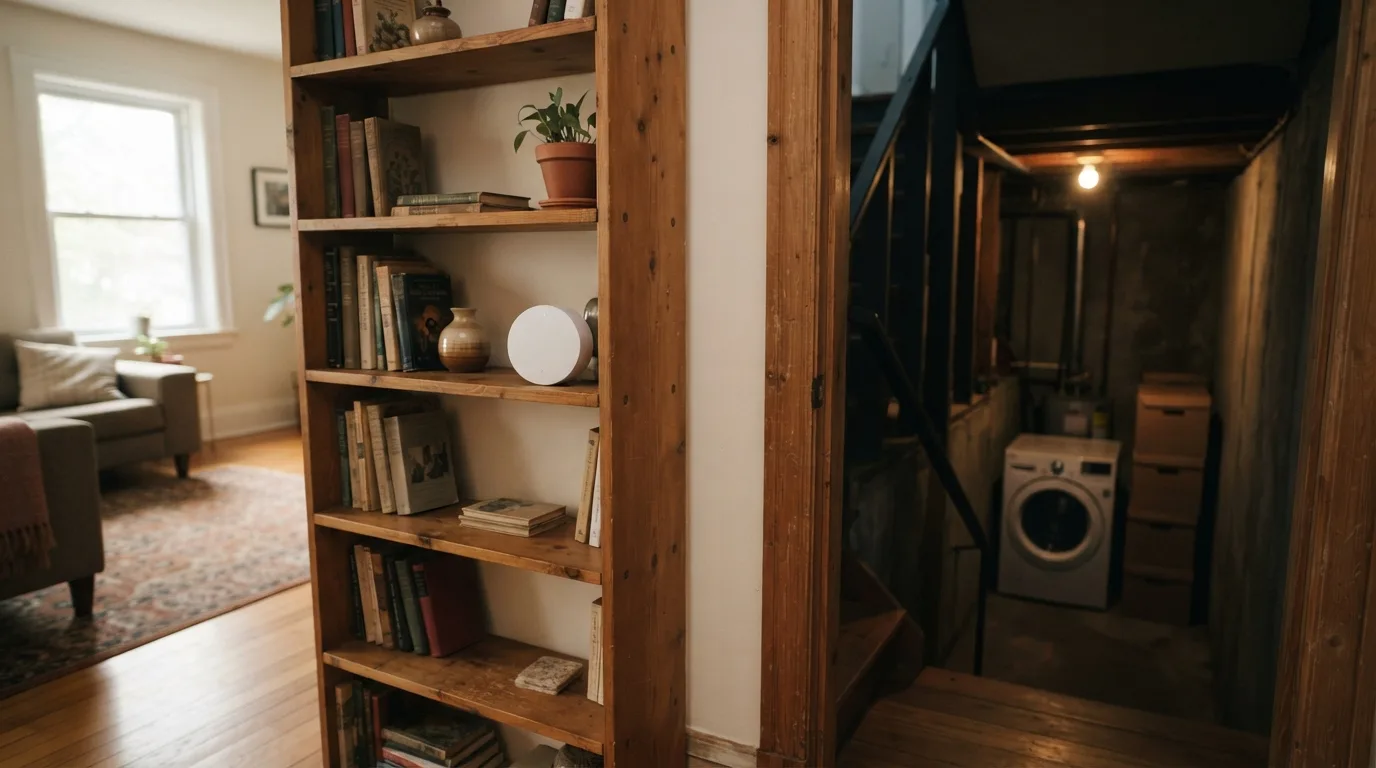
The same page leaves out a crawl space and an unfinished basement. It also leaves out rooms "normally closed off or accessed infrequently", such as a furnace room or laundry room. The City of Hamilton's public health radon page gives an example. For a basement with "only a laundry room and storage area", it says "the device should be placed on the first floor of the home".
Time averaged over a year counts too. Health Canada's measurement guide gives the example of Anne, who spends 12 hours a day in her basement studio on most weekends and a few hours during the week, so averaged over a year her basement counts. Health Canada's guide also puts bedrooms on the main floor or basement first, since people spend the most time there.
Why does the basement usually read higher than the first floor?
The basement is the part of the house nearest the ground, where most indoor radon comes from. Health Canada's measurement guide says "Soil gas is the largest source of indoor radon". It adds that "Radon levels are typically highest in basements and crawl spaces, as these locations are closer to the source and poorly ventilated".
Air pressure plays a part as well. The same guide defines the stack effect: warm air rises and leaves a heated house, and "the lower levels of the home become depressurized". The openings radon uses and how that pull works are set out in where radon gets into a Toronto home.
Upper floors tend to read lower for a second reason. The 2024 Cross-Canada Survey of Radon Exposure, a research report by university researchers working with Health Canada, says "Building scientists believe" radon gets diluted there by air from openings such as windows and doors. Health Canada's guide still warns that high radon levels can be found throughout a home, not only below ground.
How much higher does a basement read, on average?
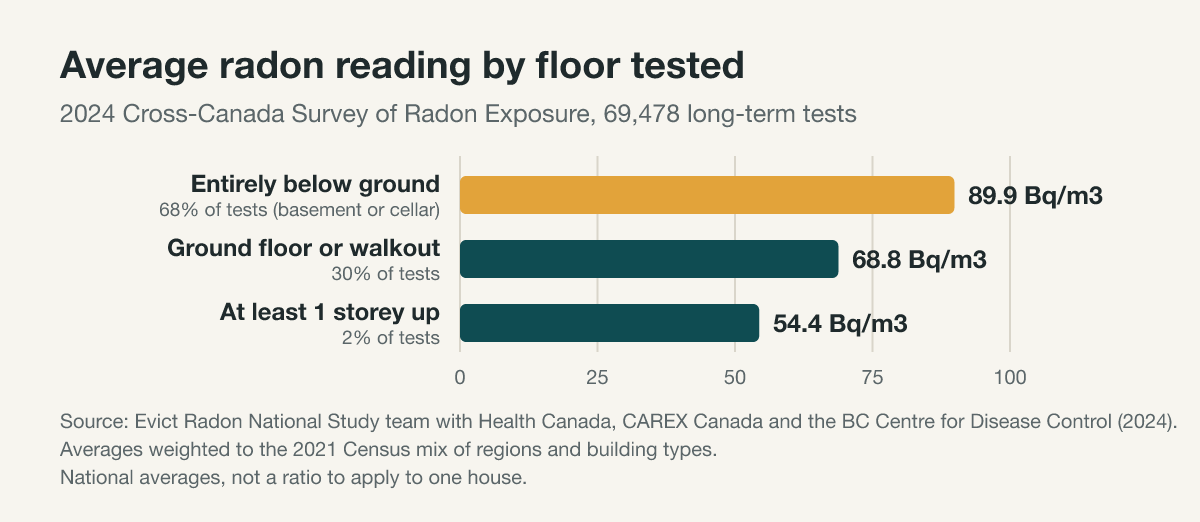
On national averages, basement tests read higher than ground-floor tests in the 2024 Cross-Canada Survey of Radon Exposure. That survey pooled 69,478 long-term tests. The university-based Evict Radon National Study team wrote it, with Health Canada's National Radon Program among its funders and Health Canada staff among its collaborators.
Of those tests, 68 percent sat on a floor entirely below ground, such as a basement or cellar, 30 percent on the ground floor or a walkout level, and 2 percent at least 1 storey above ground. Weighted to the 2021 Census mix of regions and building types, the survey's average reading was 89.9 Bq/m3 below ground, 68.8 Bq/m3 on the ground floor and 54.4 Bq/m3 at least 1 storey up.
Those are census-weighted national averages, not a ratio to apply to one house. The report itself says its results should not be used "to decide whether to test a specific household for radon".
Health Canada's measurement guide agrees that "Radon can vary widely between homes", even on the same street. RadonIndex holds no radon readings of its own for any home, street or city in the Greater Toronto and Hamilton Area (GTHA).
What does a high reading from an unused basement mean?
It describes that basement; it does not tell you the level on the floor your household uses most. Health Canada's measurement guide says "The basement is only considered a potential measurement location if it includes a normal occupancy area". Its sample wording for an off-guidance test calls the result "still valid for the location that was tested". It adds that devices in non-standard locations "may not provide a sufficient estimate of an average annual radon level".
Where the detector sat matters too. Health Canada's guide says not to place one near sump holes, in crawl spaces or next to exposed foundation cracks, because those spots "may artificially increase measured levels". A detector on a storage shelf beside the sump breaks both rules at once.
The Health Canada pages checked for this guide set no rule for a high number from an unused room. That suggests treating it as a prompt to run a proper long-term test on the lived-in floor, as how to test a GTHA home for radon explains. Health Canada's measurement guide adds that "any action taken that reduces an individual’s radon exposure corresponds to a decrease in their health risk".
What if nobody lives below the first floor, or the home sits above ground?
Then the lowest floor that someone does live on is the test floor. Health Canada's radon action guide for provinces and territories describes testing "in the lowest regularly occupied level of the home (basement or main floor)". A house on a slab or over a crawl space follows the same rule, and Health Canada's measurement guide keeps the detector out of the crawl space.
Homes off the ground still need a test. Health Canada's measurement guide says homes whose lowest lived-in level does not touch the ground "typically have lower radon levels", but "they can still have a level above the guideline". For large buildings, Health Canada's guide for public buildings puts testing "on floors in contact with the ground", and owners worried about upper levels "could also test upper floors". What that means for one unit is in radon in a Toronto condo or apartment.
Should you test both floors?
You can, but only the lowest lived-in floor gives the number Health Canada compares with its guideline. Health Canada's measurement guide says "Only one (1) detector is required to perform a measurement in accordance with this guidance". A second detector upstairs is extra information, not a second verdict.
If you do test 2 floors, each needs a full long-term test. Health Canada's guide asks for tests "over a period of 3 to 12 months", with "a minimum of 91 days of the test" in the heating season. An electronic radon monitor (ERM), a device that logs readings, can move between floors, but Health Canada's guide says to reset it for each new location. Placing 2 long-term detectors at once gives both answers in 1 heating season.
When does the floor that counts change?
It changes when a lower level starts being used. Health Canada's measurement guide asks for a new test the next heating season if a floor that was not tested "has since become the lowest lived-in level of the home". It asks for one after "renovating the basement", too.
Health Canada's guide already counts rooms that "may become occupied soon", such as a basement being renovated to add a bedroom. By the guideline page's own list, a new basement apartment also moves the test floor down. More people now test below ground than in 2012, and the university researchers behind the 2024 Cross-Canada survey speculate this "may reflect the increased use of such spaces as living areas".
Who in the GTHA can place the detector on the right floor?
Most companies in RadonIndex say they test for radon. Of the 35, 31 say on their own website that they do radon testing. By Google Maps labels, 16 of those 31 are home or building inspectors. The methodology page explains how the list is built.
Health Canada's measurement guide lists "Room and floor where the device was placed in the home" among the supplementary details a professional report should include where appropriate. Ask which floor they will test and why before you book. The Canadian National Radon Proficiency Program (C-NRPP) certifies people, not companies. Only 5 of the 35 companies say on their own website that they are C-NRPP certified. Ask for the person's certification number and enter it on the C-NRPP certification check, and see the full list on the radon testing page.
Frequently asked questions
Is radon worse in the basement or on the first floor?
- Usually the basement. Health Canada's measurement guide says levels are typically highest in basements and crawl spaces, but that high radon levels can be found throughout a home. A lower first floor is a tendency, not a promise. The only way to know the level on the floor you live on is a long-term test on that floor.
Should I test my basement if I only use it for laundry?
- No. The Health Canada radon guideline leaves the laundry room and an unfinished basement out of the normal occupancy area. Health Canada's guide lists a bedroom, living room or office as suitable spots for the detector, so on the first floor those are the rooms to use. Health Canada's measurement guide also rules out the kitchen and bathrooms, because they typically have different air quality and ventilation from the rest of the home.
My unused basement tested high. Do I have to act?
- The Health Canada radon guideline applies to the normal occupancy area, so a sensible next step, RadonIndex's suggestion rather than a Health Canada rule, is a long-term test on the floor you use. If you plan to use the basement, test it as a lived-in space. A C-NRPP (Canadian National Radon Proficiency Program) professional can explain what the basement number suggests before you decide.
Do I need to test the upper floors of a house?
- Not for the guideline. Health Canada's measurement guide says "Only one (1) detector is required" and puts it on the lowest lived-in level. A second detector upstairs is optional. The lowest lived-in floor still decides whether the home is above Health Canada's guideline of 200 becquerels per cubic metre (Bq/m3).