Radon in a Toronto Condo or Apartment
Last updated: By RadonIndex Research Team
Height helps, and it does not settle the question
Radon comes out of the ground. That single fact sets the shape of the answer for a tower. The units in contact with the soil, or close to it, are the ones where a meaningful level is most likely. The ones high above it are further from the source.
So far this is the intuition everybody already has, and it is broadly right. What it misses is that a tall building is not a stack of separate houses. It is one connected volume with shafts running through it. Health Canada's guide for radon measurements in public buildings records the consequence directly. "In some cases, higher radon concentrations have been found at upper levels, due to radon movement through elevator shafts or other service shafts in buildings, or due to the stack effect".
That is not a warning that high floors are secretly dangerous. It is a warning that floor number is a probability, not a measurement. The only thing that tells you about a specific unit is a detector in that unit. This is the same argument our guide on where radon gets into a Toronto home makes about neighbouring houses, applied vertically instead of sideways.
Why a tower behaves differently from a house
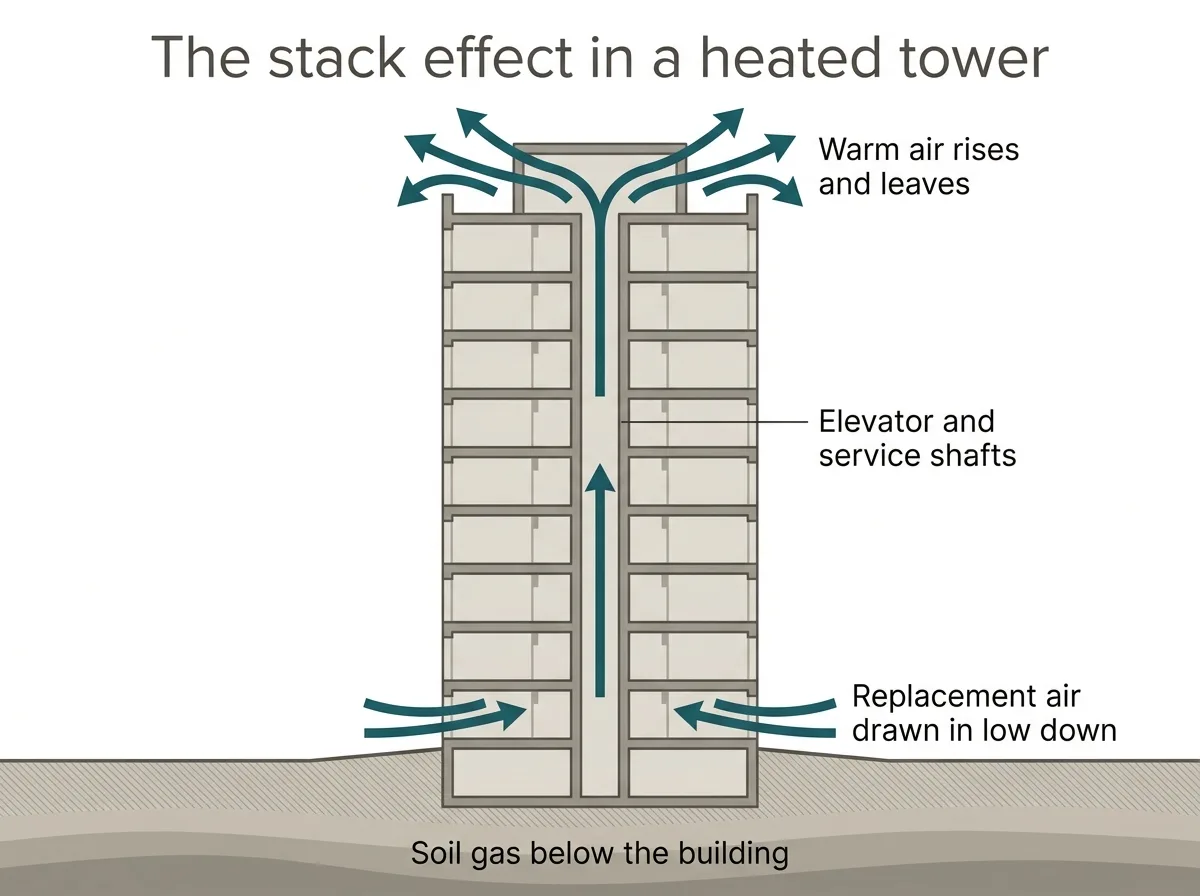
The mechanism has a name, and Health Canada defines it in plain words. "Stack effect refers to the movement of air in and out of a building: warm air rises and exits through the upper parts of a building, drawing new air in through the lower parts of the building".
In a two storey house that effect is modest, and it mostly explains why the basement is the place to measure. In a heated tower in a Toronto January it is the dominant air movement in the building. Warm air leaves at the top, and the replacement has to come from somewhere. Some of it comes through the front doors, and some of it comes from the lowest levels of the structure, which are the levels in contact with soil.
Elevator shafts, garbage chutes, stairwells and service risers are the paths that connect those two ends. They are exactly the vertical, continuous, unobstructed routes that air uses. That is the whole of the explanation for why a high floor can occasionally read higher than the floor below it.
One more difference is worth stating because it changes who can act. In a house, the person measuring owns the slab, the sump and the fan. In a condominium, the person measuring owns the air in one unit and the corporation owns nearly everything that determines what is in it.
Whose building is it to test
Health Canada does not treat an apartment building as a large house. Its guide for public buildings sets out the category, and the list is broad. "Multi-unit dwellings can include any building used as a residence by more than one family unit and can include apartment complexes, dormitories, military residences, boarding houses, hotels, convents, monasteries, motels, and live/work units. It can also include those buildings with shared ownership or maintenance such as co-op units, townhouses, condominiums, stratas or vacation timeshare properties".
A condominium is named in that list. So is a townhouse with shared maintenance, which catches a lot of the Greater Toronto Area's stock that nobody thinks of as a tower.
The practical division that follows is straightforward. A building wide picture, and anything that would change it, sits with the owner or the condominium corporation, because the systems that move air through the building are theirs. Your own unit is yours to measure whenever you want.
On how much of a building to cover, Health Canada's approach for these buildings is to "test all occupied rooms" on the levels of interest. Where a board is worried about the upper floors, it adds that "optional testing could be carried out in every third occupied room on the highest occupied floor". That is a programme for a building manager rather than a shopping list for a resident, and it is the right thing to put in front of a board that asks what testing would involve.
How to measure your own unit
Nothing about the method changes because you are in an apartment. You want a long term detector and you want it to see the heating season.
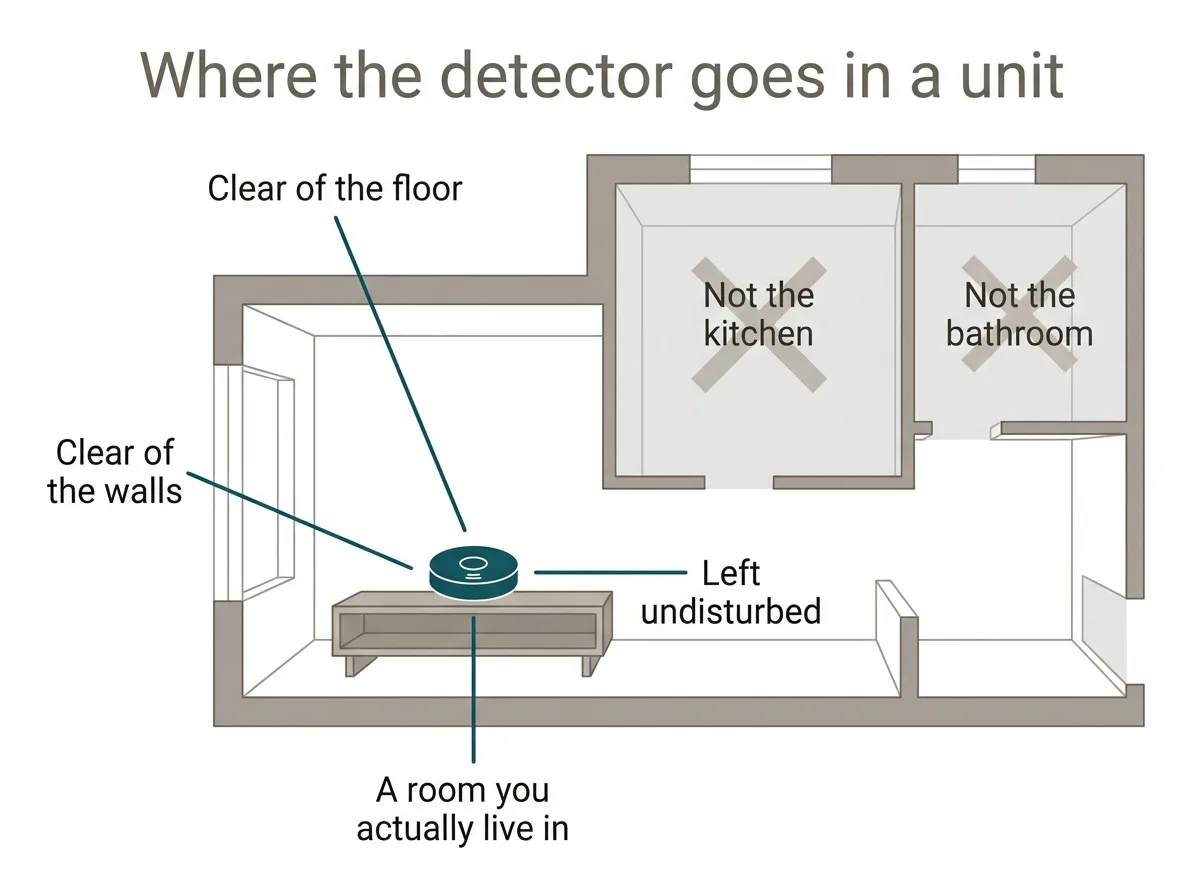
Health Canada's guide for radon measurements in homes asks for a test "over a period of 3 to 12 months", arranged so that "a minimum of 91 days of the test is during the heating season". Its placement rules are equally specific: "in a room on the lowest level of the home with a normal occupancy area", "at least 30 cm, or 1 ft, above the floor" and "at least 30 cm from walls or ceilings". For the public building case it puts the same requirement more briefly, that "radon detectors should be deployed for at least three months during the heating season".
Translated to a unit: the lowest room you actually live in, which in a one level apartment is simply a room you use rather than a storage closet. Not on the floor, not against a wall, not in a kitchen or bathroom where humidity and ventilation are unusual, and not somewhere it will be moved. Then leave it alone for the winter.
Where to get the detector is covered in where to get a radon test kit in Ontario, and what a kit costs, with each figure traced to its source, is on the radon testing cost guide.
What happens if a result comes back high
The guideline does not change for apartments. Health Canada's radon guideline asks that "you take corrective action if the average annual radon level exceeds 200 Bq/m3 in the normal occupancy area of a building", and that the action be taken "within 1 year". Two pieces of that sentence are worth unpacking. A becquerel per cubic metre, written Bq/m3, is the unit radon in air is measured in, and the normal occupancy area is the part of the home people actually live in rather than a crawl space. It is equally clear that this is not a safety line: "while the health risk from radon exposure below the Canadian guideline is small there is no level that is considered risk free".
What differs is who acts. In a house the owner hires a contractor and a pipe goes under the slab. In a condominium the work touches the structure, the mechanical systems and the common elements, so it goes to the corporation. A resident's realistic first steps are to document the result, share it with the board or property manager in writing, and ask what the building's own testing has shown.
That is a slower road than a homeowner's, and it is worth being honest about it rather than implying a resident can simply book a fix. Health Canada's reduction guide does give you the name to ask for when the building does act. It recommends hiring "a professional certified under the Canadian National Radon Proficiency Program (C-NRPP)", the national scheme that certifies radon workers. It also tells you the question to ask: "can the contractor provide proof of C-NRPP certification?"
One thing worth knowing before the conversation gets discouraging: the technique used on houses is not a marginal one. The reduction guide calls sub-slab depressurization "the most effective and reliable radon reduction technique", and the principle carries over to larger buildings even though the engineering is bigger. How a radon mitigation system works explains the principle.
What this directory holds, and what it does not
This site is built around houses, and you should know that before you use it for a tower.
RadonIndex holds 35 company records for the Greater Toronto and Hamilton Area, recounted from our own data today. 31 name radon testing on their own website and 12 name mitigation. A large share of the testing records are home inspection businesses, whose normal work is a single family house rather than a multi-storey residential building.
That does not make the list useless for a condo resident. A long term test of one unit is the same job in any building, and a testing company can do it. It does mean something for a board. If the job is a building wide programme, or a mitigation design for a tower, you want a firm that does commercial and multi-unit work. Ask them directly whether that is what they do. Five of our 35 records state a C-NRPP style claim in their own site text, which we record and do not verify.
The lists are radon testing companies and radon mitigation contractors, and how a company gets onto either is in our methodology.
Frequently asked questions
Do condos and apartments have radon?
- They can. Radon comes from the ground, so the lowest occupied floors are the most exposed. Health Canada also records that higher concentrations have been found at upper levels, because radon moves through elevator shafts and other service shafts, and because of the stack effect. Health Canada includes condominiums and apartment complexes in the multi-unit dwellings its public buildings guide covers.
Can radon reach a high floor in a building?
- Sometimes, yes. Health Canada states that higher radon concentrations have been found at upper levels, due to radon moving through elevator shafts or other service shafts, or due to the stack effect. It defines the stack effect as warm air rising and leaving through the upper parts of a building, while new air is drawn in at the lower parts. Levels are still generally lower higher up, but the floor number is a probability rather than a measurement.
Who is responsible for radon testing in a condominium?
- A building wide test programme and any mitigation work sit with the owner or the condominium corporation, because the systems that move air through the building and the structure being worked on are common elements rather than yours. Testing your own unit is something you can do yourself at any time. RadonIndex does not give legal advice on condominium obligations, and that question belongs with your corporation and its counsel.
Can I test my own apartment for radon?
- Yes, and it is the same method as a house. Health Canada asks for a test of three to twelve months, with at least 91 days of it in the heating season. Put the detector in a room on the lowest level you normally occupy, at least 30 cm above the floor and at least 30 cm from walls or ceilings. A long term mail in kit is the usual tool.
Does a basement apartment have more radon?
- It is the part of a building most exposed to the source, because radon enters from the ground through the lowest floor. That makes it the right place to measure, not a reason to assume a high result. Plenty of basement units measure low, and the only way to know which one yours is is to leave a long term detector in it through the heating season.